
Your child needs a speech therapy assessment, but the nearest office has a six-month wait. A speech therapist offers to conduct the evaluation via videoconference. The question quickly arises: can a remote speech therapy assessment really replace an in-office consultation?
The answer depends on what is being evaluated, the quality of the tools used, and sometimes the type of suspected disorder. Not all assessments lend themselves equally to a remote format.
Reliability of measurements in tele-speech therapy: what changes compared to the office
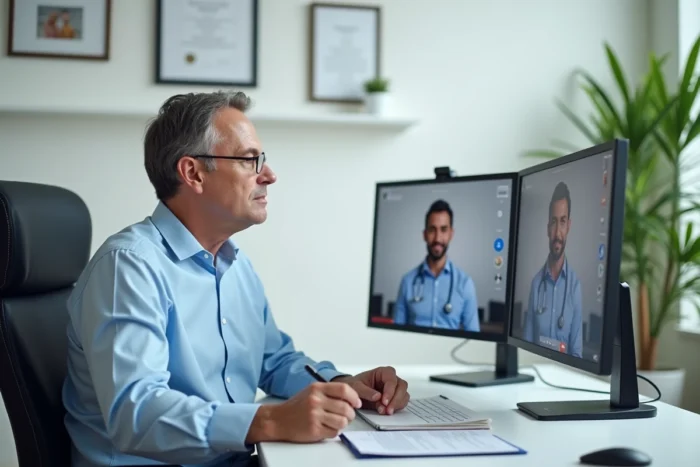
In the office, the speech therapist observes posture, breathing, and fine movements of the mouth. Remotely, some of these observations are still possible thanks to the camera, but the accuracy heavily depends on the quality of the connection and equipment.
The current issue is no longer just whether videoconferencing “works.” Recent practices emphasize the reliability of the metrics used remotely. Tools for measuring speech rate and comparable scores over time allow for standardized evaluation, regardless of the format.
Assisted writing also reduces the time spent analyzing results. The professional spends less time formatting the report and more on clinical analysis. In practical terms, this means that the quality of the remote speech therapy assessment on Santé Quotidienne relies as much on the measurement instruments as on the communication channel.
For oral or written language disorders (speech delay, reading difficulties), tests adapted for videoconferencing yield results comparable to those obtained in person. Countries like Canada and the United States have recognized tele-speech therapy as an equally effective practice as in-office consultations for both evaluation and intervention for several years.
Remote speech therapy assessment or pre-assessment: when to switch to in-person
You may have noticed that a child does not stutter the same way when reading aloud, recounting their day, or chatting with a peer? This phenomenon of variability in the disorder poses a real methodological problem remotely.
The trap of a single sample in videoconferencing
For stuttering, a single speech sample can be misleading. If the child is experiencing a fluent period on the day of the evaluation, the assessment will underestimate the severity of the disorder. Conversely, the stress of videoconferencing can amplify disfluencies. It is necessary to compare multiple speech contexts (reading, conversation, naming, spontaneous speech) to avoid a biased conclusion.
In the office, the speech therapist can observe these variations on-site and adjust testing situations in real-time. Remotely, this flexibility decreases. The professional depends on what the camera shows, in a single setting.
Clinical signs that require an in-person examination
Some situations make remote assessments insufficient. It then becomes a pre-assessment, a first orientation step that must be completed in the office.
- Oro-myofunctional disorders: examining swallowing, tongue mobility, or cheek tone requires close observation, sometimes with a tongue depressor. The camera is not enough.
- Suspected autism spectrum disorder in young children: evaluating social communication (gaze, pointing, joint attention) requires observing the child in a controlled space with physical materials.
- Severe praxic difficulties: when the coordination of oral-facial movements is at stake, the assessment requires precise manipulations that remote formats do not allow.
- Very young patients (under three years): keeping a toddler’s attention on a screen for the duration of an assessment remains a challenge that compromises the validity of observations.
In these cases, the mixed format offers the best compromise. Anamnesis and parental questionnaires are done remotely. Clinical tests that require fine observation take place in the office.
Concrete process of a speech therapy assessment via videoconference
Why detail the steps? Because the session does not quite resemble a traditional in-office consultation, and a few practical points change the patient’s experience.
Before the session
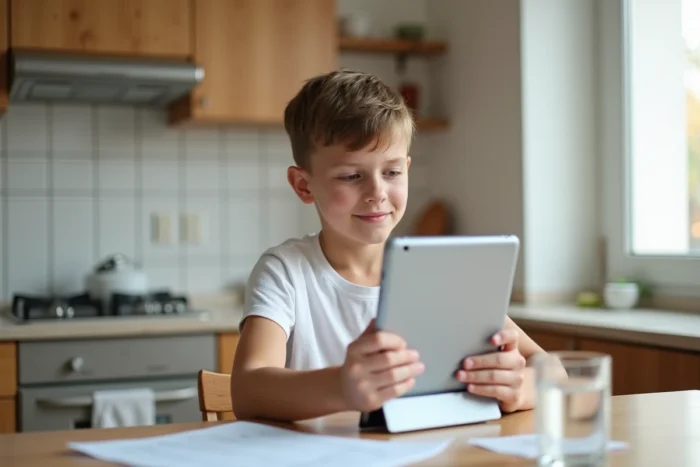
The speech therapist sends a preliminary questionnaire (medical history, language development, schooling). This document partially replaces the initial interview and saves time on the day of the assessment. The patient or family must have a stable connection, a computer or tablet with a camera, and a quiet space.
During the evaluation
The session generally follows the same pattern as in the office. The speech therapist begins with an interview to understand the request, then proposes tasks adapted for videoconferencing. Exercises for repeating words, oral comprehension, reading, or writing lend themselves well to the screen format.
Screen sharing replaces physical materials: images, texts, and visual instructions are displayed directly. For written tasks, the child or adult can write on paper and show their sheet to the camera.
After the assessment
The report is written as it would be for a classic assessment. It specifies the diagnosis, rehabilitation goals, and the recommended number of sessions. This document is sent to the prescribing physician for care management.
Tele-speech therapy consultation and reimbursement: regulatory framework still unclear
In France, telecare in speech therapy was greatly facilitated during the Covid period. However, the regulatory rules remain poorly understood by some patients and professionals.
Tele-speech therapy consultations are reimbursable by Health Insurance, provided that the coordinated care pathway is followed. This requires a prior medical prescription, just like for an in-office assessment. The doctor’s prescription remains mandatory, whether the session takes place via videoconference or in person.
The remote speech therapy assessment is not suitable for all situations, and this is precisely what makes it a reliable tool when used appropriately. A professional who offers a mixed format or directs towards in-person after an initial exchange via videoconference demonstrates clinical rigor, not a lack of digital competence.