
The term “prospect” circulates in all commercial and marketing departments, often without a consensus on what it exactly encompasses. Between the contact who simply left an email address and the one who requested a quote, the distance is considerable. Yet, both are referred to by the same name in most CRMs. This imprecision has direct consequences on sales strategy and the regulatory compliance of prospecting actions.
What GDPR Changed in Prospect Qualification
Before GDPR, qualifying a contact as a prospect was almost exclusively a commercial choice: if the person matched the target profile, they became a prospect. European regulation added a legal layer that concretely modifies practices.
The CNIL distinguishes two regimes. In B2C, sending electronic prospecting requires prior opt-in from the contact. Without explicit consent, the contact is not an actionable prospect, regardless of their presumed interest in the offer. In B2B, prospecting without consent remains permitted, but only under the legitimate interest regime: the message must relate to the recipient’s professional role, and the subject of the message must be relevant to that role.
By understanding the definition of a prospect from this regulatory angle, we see how much the boundary between a simple contact and an actionable prospect has hardened. A file of thousands of names has no marketing value if the legal basis for each entry is not documented.
This constraint has an unexpectedly positive effect: it forces teams to work with smaller but better-qualified databases, which mechanically improves conversion rates.
Prospect and Lead in Marketing: A Boundary That Depends on Your Internal Criteria
The distinction between “lead” and “prospect” does not rely on a universal definition. Depending on the companies, the same words refer to very different realities.
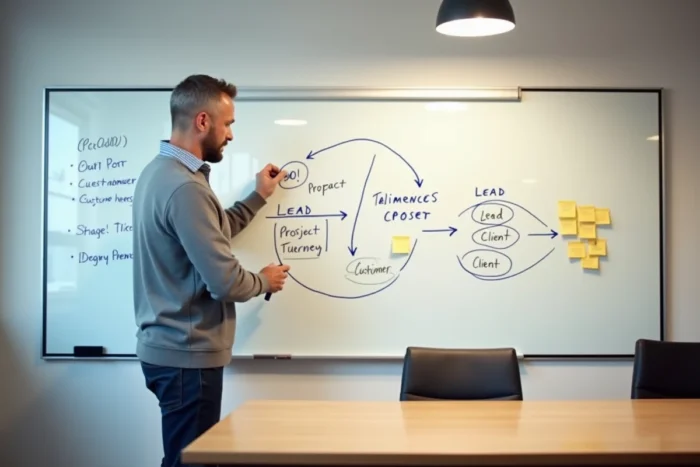
A lead, in most organizations, refers to a raw contact: an address collected via a form, a participant in a webinar, a visitor who downloaded a white paper. The prospect, on the other hand, has crossed a qualification threshold specific to each company.
This threshold generally relies on the combination of two elements:
- The fit between the contact’s profile and the company’s ideal customer (what sales teams call the ICP, or Ideal Customer Profile): industry, organization size, estimated budget, geographical location.
- Detected intent signals: pricing pages viewed, request for a demo, repeated interaction with content related to a specific product, response to a prospecting email.
- The availability of an actionable legal basis (documented consent or proven legitimate interest in B2B), without which the contact remains a dormant lead.
A contact that checks all three boxes becomes a qualified prospect. A contact that checks only one remains a lead to be nurtured. Without formalized internal criteria, the distinction loses all operational meaning.
Intent Signals and Behavioral Data: Qualifying a Prospect in 2026
The most structuring trend in recent years is the use of intent data to identify prospects even before they fill out a form. The idea is simple: analyze digital behaviors to spot contacts actively searching for a solution.
What Intent Signals Reveal
A prospect who consults multiple CRM software comparisons, visits the pricing pages of three different vendors, and posts on LinkedIn about changing tools sends converging signals. Taken in isolation, each signal is weak. Aggregated, they outline a hot prospect profile that sales teams can contact at the right time.
Current prospecting tools cross-reference these behavioral data with ICP criteria to assign a score to each contact. Scoring is gradually replacing the cold-warm-hot ranking, which is too subjective, with a continuous scale fed by verifiable data.
Limitations of the Intent Data Approach
Predictive scoring does not yield the same results everywhere. Companies with large volumes of visitors and digital interactions derive measurable benefits. For smaller organizations, with little web traffic and long sales cycles, scoring can produce costly false positives in sales time.
The quality of intent data also depends on its source. Proprietary data (behavior on your own site, email opens, incoming requests) is reliable. Third-party data, aggregated by specialized platforms, raises questions of freshness and contextual relevance.

Prospect in Sales Strategy: Why Vocabulary Matters
The terminological ambiguity surrounding the word “prospect” creates a concrete alignment problem between marketing and sales. When marketing passes a list of “qualified prospects” to the sales department that are actually just leads who opened an email, the friction is immediate. Salespeople waste time, conversion rates drop, and each team ends up blaming the other.
The solution lies in a documented internal agreement, often formalized in an SLA (Service Level Agreement) between marketing and sales. This document specifies:
- The exact criteria that move a contact from lead status to prospect status (scoring threshold, triggering actions, manual or automatic validation).
- The maximum time frame for the sales team to make contact once the prospect is passed on.
- The nurturing actions that marketing continues to provide on unqualified leads, to gradually bring them to the qualification threshold.
A well-defined prospect internally reduces the sales cycle because salespeople focus their energy on contacts whose intent and fit have already been verified. The gain is not only measured in revenue: it also translates into reduced team burnout, as they stop chasing unripe contacts.
Formalizing this definition in a shared SLA between marketing and sales remains the most direct lever to ensure pipeline reliability and shorten closing times.