
Buying a chalet in a residential leisure park with a plot transfer in Vendée amounts to acquiring two distinct assets: a land lot registered in the land registry and a light dwelling placed on it. This dual nature alters the legal, tax, and heritage interpretation of the file compared to a simple rented location in a campsite. What cost, protection, and constraint differences separate this arrangement from a classic real estate purchase or a plot rental in a residential leisure park?
Plot transfer and location rental in a residential leisure park: differences in rights and risks
The confusion between the two formulas remains common. Comparing their main characteristics allows us to measure what we are actually buying.
| Criterion | Plot transfer (full ownership) | Location rental |
|---|---|---|
| Legal nature | Land lot identified in the land registry, notarial deed | Lease (variable duration, renewable or not) |
| Ownership of the land | Yes, free resale | No, the land remains with the manager |
| Control of the chalet | Free choice subject to park regulations | Model often imposed or limited by the lease |
| Capital gain on resale | Classic real estate capital gains regime | Resale of the chalet alone, frequent depreciation |
| Risk in case of change of manager | Low (landowner) | High (possible end of lease) |
In a plot transfer, the land constitutes a full-fledged real estate asset. The owner has an enforceable title of ownership, which secures resale and access to bank financing. In contrast, location rental relies on the strength of the lease and the goodwill of the manager.
Financing such a project requires clearly distinguishing these two items. The separate allocation between the plot and the chalet in the notarial deed conditions both the loan arrangement and the subsequent tax calculation. If you are considering the purchase of a chalet in a residential leisure park with plot transfer in Vendée, this allocation should be negotiated as early as the preliminary agreement.

Internal regulations and urban planning constraints in Vendée: checks before signing
Becoming a landowner in a residential leisure park does not grant carte blanche on construction. The park’s internal regulations may restrict the choice of chalet manufacturer, facade materials, maximum height, or even the allowed color palette. These clauses are included in the specifications attached to the deed, and they survive a change of manager.
The urban planning certificate remains the key document in the file. In Vendée, where the coastline is largely covered by risk prevention plans, it is essential to check the actual zoning of the plot, any easements, and exposure to natural risks (marine submersion, shrink-swell of clays). An operational urban planning certificate, requested at the town hall, confirms that the chalet project is feasible on the targeted lot.
Points to check before signing the preliminary agreement
- The operational urban planning certificate, which validates the type of construction allowed and the available connections on the plot.
- The coastal risk prevention plan (PPRL) applicable to the municipality, to identify construction constraints or adaptation obligations.
- The internal regulations of the residential leisure park in its current version, requesting the history of modifications over the past five years.
A chalet compliant with the park’s regulations but located in a high-risk area according to the PPRL may become unbuildable or uninsurable in the long term. Cross-referencing the park’s regulations with the municipal urban planning document avoids this deadlock.
Change of regulations or classification of the residential leisure park: what consequences for the owner
The least documented angle concerns the regulatory stability of the park after purchase. A residential leisure park operates under an administrative authorization regime that can evolve. Three scenarios deserve attention.
The manager may modify the internal regulations, for example by prohibiting seasonal subletting or imposing new aesthetic standards. If you own the plot, these modifications do not challenge your land title, but they may limit the use or rental profitability of the chalet.
The urban planning classification of the area may also change during a revision of the local urban planning plan. A plot classified as a leisure zone may be reclassified as a strict natural zone, making any extension or reconstruction impossible. The land ownership remains, but the heritage value is affected.
The third case concerns the bankruptcy or withdrawal of the manager. In a plot transfer, the owners retain their lots. They must then organize collectively (often through a free union association) to ensure the maintenance of common areas and the upkeep of facilities. Post-manager collective management is not provided for in any standard contract, making the drafting of the subdivision statutes crucial from the outset.
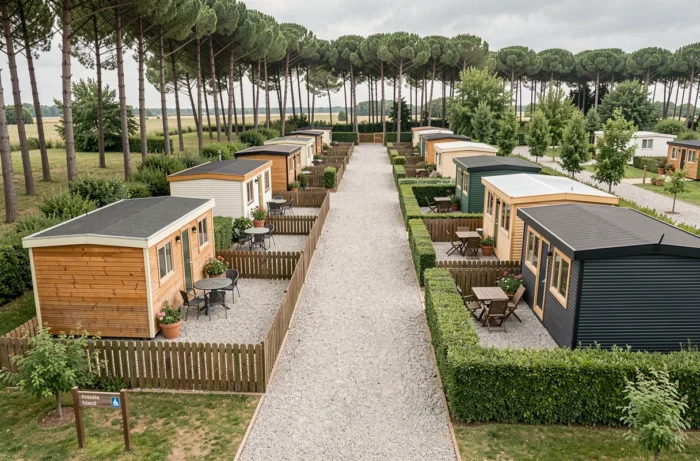
Taxation on the resale of a chalet in a residential leisure park with plot transfer
The capital gain realized upon resale follows the classic regime for capital gains on real estate for individuals. Total exemption only occurs after a long holding period, with progressive deductions for each year beyond the fifth.
For a property acquired as a secondary residence, the holding period directly conditions the tax burden upon resale. Reselling after a few years generates significant taxation on the difference between the acquisition price (plot plus chalet, including notary fees) and the selling price.
- The acquisition price considered by the administration includes the plot, the chalet, and the deed fees, provided that the allocation appears in the original notarial deed.
- Improvement works carried out by the owner may increase the acquisition price, subject to supporting documents (invoices, permits if necessary).
- The exemption for the principal residence only applies if the chalet constitutes the effective tax residence of the seller on the day of the transfer.
Anticipating this taxation from the moment of signing allows for calibrating the minimum holding period and avoiding an unpleasant surprise upon resale. A purchase thought out for the short term in a Vendée residential leisure park with plot transfer often carries a tax burden that is frequently underestimated in light of the appeal of the living environment.