
A fennec weighing less than two kilos that digs into the tiles, urinates on the walls, and makes high-pitched cries at three in the morning: this is the real daily life that most unprepared owners discover. Before falling for its oversized ears, one must face a strict administrative process, a significant budget, and custody constraints that few homes can comply with.
Capacity certificate and prefectural authorization: the real administrative process
The fennec (Vulpes zerda) is classified as a non-domestic pet in France. The law requires a capacity certificate issued by the DDPP of the department, and depending on the case, a prefectural authorization for possession. Without these documents, one risks up to one year in prison and a fine of up to 15,000 euros.
The application for a capacity certificate is not a formality. It requires proof of practical experience with non-domestic species, often validated by internships in zoos or with licensed breeders. The file is then reviewed by a departmental commission, and processing times vary by prefecture.
One point that is often underestimated: the fennec is listed in Annex II of CITES. Every animal must be accompanied by valid CITES documents. Importing a fennec without a permit can lead to penalties of up to three years in prison and a fine of 150,000 euros under the customs code. When one wants to adopt a domestic fennec in France, the first step is to compile this complete administrative file even before contacting a breeder.

Acquisition budget and veterinary costs for a non-domestic fennec
The purchase price of a fennec from a registered breeder is in a high range, often between one thousand and several thousand euros. This price does not include setup or recurring costs.
The initial setup represents a significant expense. We are talking about a secure enclosure (the fennec digs and jumps high), an appropriate heating system, and specific bowls. The initial setup cost can easily double the price of the animal.
Finding a competent non-domestic veterinary
The most concrete daily difficulty remains access to care. Very few veterinarians in France are skilled in wild canids. We are not talking about a dog or cat for which any clinic would suffice. It is necessary to identify a specialized non-domestic veterinarian, sometimes several hours away by car.
Specialized consultations cost significantly more than in standard canine medicine. No standard pet insurance covers a fennec. Feedback varies on this point, but the majority of owners report covering all veterinary expenses without assistance.
Feeding the fennec in captivity: creating an appropriate diet
In the wild, the fennec is an opportunistic omnivore. It consumes insects, small rodents, eggs, fruits, and roots. Replicating this balance in captivity requires daily effort that cannot be compared to simply opening a bag of kibble.
- Animal proteins in the form of live insects (crickets, mealworms) and small portions of raw meat form the basis of the diet.
- Fresh fruits and vegetables (melon, zucchini, figs) complement the fiber and water intake, but in moderate quantities to avoid digestive issues.
- Taurine supplements are sometimes necessary, as the fennec, like the cat, does not synthesize it in sufficient amounts.
An inappropriate diet causes visible bone deficiencies within a few months. Fennecs fed exclusively with dog food frequently develop kidney and joint problems.
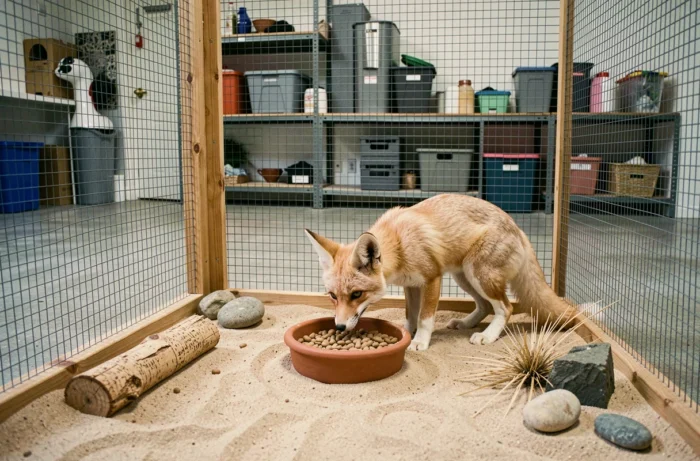
Conditions of custody and housing arrangements
The fennec is a nocturnal, territorial animal capable of jumping over a meter high. In an apartment, this poses concrete problems that must be anticipated.
Indoor and outdoor enclosures
A wire enclosure with a reinforced floor (the fennec digs burrows in a few hours) is the minimum requirement. The enclosure’s surface must allow for real physical activity, not just a corner of the living room. Some prefectures require minimum dimensions as part of the custody authorization.
Outside, the fencing must be buried several dozen centimeters deep and covered from above. The fennec can escape through the smallest opening.
Temperature and noise disturbances
Originating from the Sahara, the fennec does not tolerate temperatures below fifteen degrees well. An auxiliary heater in the living space is often necessary in winter, even in the south of France.
Nocturnal vocalizations pose a real problem in shared housing. The fennec emits piercing cries, yips, and barks. In co-ownership, noise complaints are common. This factor alone disqualifies the majority of urban housing.
- Check the co-ownership regulations, which often prohibit non-domestic species.
- Plan for a dedicated room, soundproofed, for nighttime activity periods.
- Ensure that the lease allows for the possession of non-domestic pets if renting.
Life expectancy and long-term commitment
A fennec in captivity can live for over a decade. We are not talking about a pet that can be easily entrusted to someone else in case of moving or changing circumstances. Specialized shelters are rare, and rehoming a fennec is legally complicated since the new owner must also have a capacity certificate.
The fennec does not domesticate like a dog. Even if raised by hand, it retains wild behaviors: urine marking, defensive biting, furniture destruction. Emotional attachment does not compensate for daily practical constraints.
Before committing, it is advisable to spend time with a licensed breeder or at a wildlife park that houses fennecs. Observing the animal in its real custody conditions, with its smells, noise, and nocturnal rhythm, allows for an informed decision rather than an emotional one.