Palermo is not visited like Florence or Rome. The urban fabric overlays Arab, Norman, Spanish, and Italian layers in configurations that most guides flatten into a list of monuments. Here we propose a route that prioritizes on-the-ground readings, real schedules, and neighborhoods where the city still functions for its residents.
Rhythm of Palermo’s markets: Ballarò, Capo, and the decline of Vucciria
The first mistake in Palermo is treating the three historic markets as interchangeable. They are no longer.
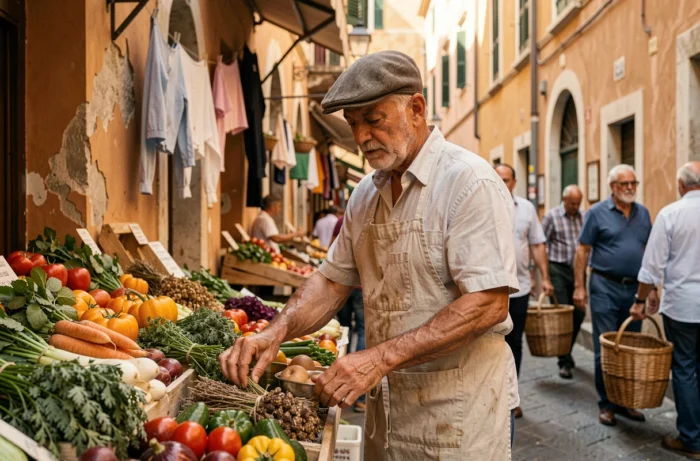
Ballarò remains the only market where Palermitans actually do their shopping. The fresh produce activity concentrates in the morning, then the neighborhood shifts to street food mode from early evening, when the stigghiola grills come out on the sidewalks. This continuity from morning to evening makes it the most reliable place to observe local life without filters.
The Capo, wedged between via Porta Carini and the Teatro Massimo, maintains an authentic morning food scene, with fishmongers and greengrocers serving local customers. Tourist footfall here is significantly lower than in Ballarò.
The Vucciria has largely ceased to function as a fresh produce market. Only a handful of stalls remain in the morning. The neighborhood has transformed into a zone of bars and nighttime street food. We recommend visiting it only in the evening, knowing that the atmosphere is more akin to the movida than to a traditional Sicilian market.
To explore these markets effectively, especially when we have a car according to AF News Travel, it is better to park near the central station and walk to Ballarò and then to Capo, reserving Vucciria for the end of the day.
Visiting hours in Palermo: building an itinerary around closures
Palermo operates on a rhythm of southern closures that systematically traps unprepared visitors. Most churches and heritage sites close between noon and around 3 PM. Planning a day without incorporating this break means losing three hours in front of closed doors.
The most effective strategy is to group indoor visits in the morning (churches, palaces, museums) and switch to markets, gardens, or pedestrian areas during the midday break.
- The Norman Palace and the Palatine Chapel generally open in the morning, but the time slots vary according to the days of the week, with frequent restrictions during parliamentary sessions of the Sicilian regional assembly that meets in the same building.
- Palermo Cathedral applies distinct hours for the nave (free access), the royal tombs, and the climb to the roofs, with the latter often being the first to reach capacity.
- The Capuchin Catacombs, located on the outskirts of the historic center, close early in the afternoon and are best scheduled for very early in the morning to avoid the line.
Checking the hours the day before on each monument’s website remains the only reliable method. The hours published in paper guides or on online aggregators are often several months out of date.
Neighborhoods off the tourist circuit in Palermo: Kalsa and Albergheria
Competing articles focus their coverage on the perimeter of Quattro Canti – Teatro Massimo – Cathedral. Two adjacent neighborhoods offer a radically different experience.
The Kalsa, an old Arab quarter located between via Alloro and the waterfront, boasts a remarkable density of medieval palaces, open courtyards, and small contemporary art galleries set in restored buildings. The Palazzo Abatellis, which houses the Regional Gallery of Sicily, deserves a long visit. The piazza Magione and the church of Magione, less frequented than Martorana, allow for an appreciation of Norman architecture without the crowds.
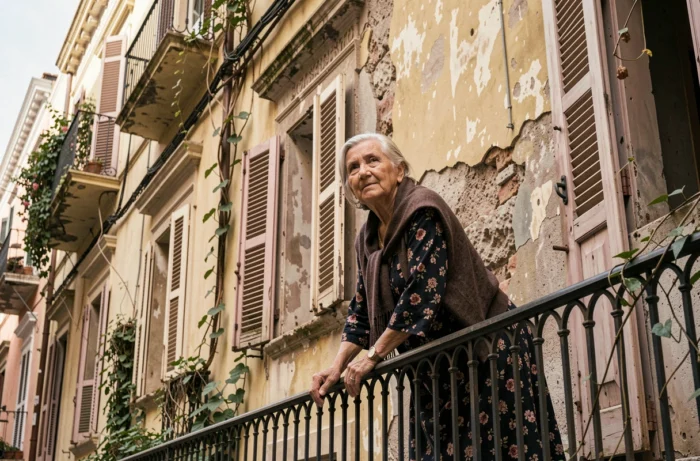
The Albergheria, which surrounds the Ballarò market, remains the most popular neighborhood in Palermo in the sociological sense. The buildings still bear the scars of the bombings of 1943, and neighborhood life (laundry hanging from windows, hallway conversations, repair workshops) is intact. It is also the area where the migrant community is most visible, with grocery stores and restaurants reflecting a contemporary and multicultural Palermo.
We observe that these two neighborhoods concentrate the most interesting responsible tourism initiatives: guided tours by local associations, participatory rehabilitation projects, artisan workshops.
Palermitan street food: distinguishing the authentic from the formatted trap
Street food has become a marketing argument in Palermo. Several stands located on tourist routes serve standardized portions at inflated prices, sometimes double what a local pays just a few streets away.
The true test of a street food stand is its local clientele. A stand frequented mainly by Palermitans, identifiable by the flow of orders in Sicilian dialect, guarantees a good price-quality ratio and fresh preparations.
Specialties to look out for:
- The stigghiola (grilled lamb intestines), served almost exclusively in the evening at Ballarò and at a few fixed points in the center.
- Pane con la milza (spleen sandwich), a dish of Jewish Palermitan origin that the stands at Capo still prepare in a traditional manner.
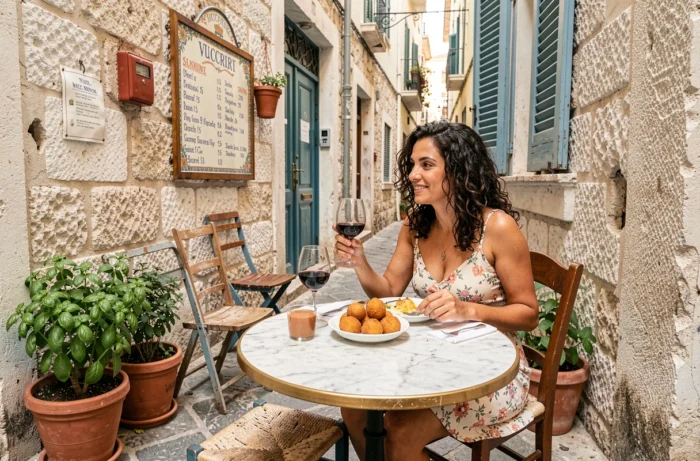
- The arancine (not arancini, in Palermitan), whose quality varies greatly from one vendor to another. Favor neighborhood friggitorie over counters located in front of monuments.
Organized food tours can be helpful for an initial orientation, but most of them follow the same routes and stop at the same partner stands. After this introduction, it is by straying two or three streets away that one finds the addresses where the price and quality have not been adjusted for an international audience.
Palermo rewards those who are willing to forgo the list of ten canonical monuments to engage in a fine reading of its neighborhoods, rhythms, and contradictions. The city does not reveal its best angles on the main thoroughfares, but in the inner courtyards of Kalsa, in front of a grill in Ballarò at 9 PM, or in the silence of a Norman church visited at 9 AM.