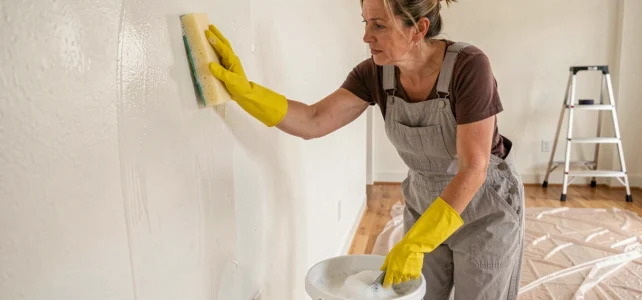
Washing a wall before painting involves removing grease, ingrained dust, and various residues that prevent the new coat from adhering to the surface. The choice of washing product directly affects the quality of this adhesion, and not all cleaners are equal depending on the condition of the wall and the type of dirt to be treated.
Surface residues and adhesion: what happens chemically before painting
A wall that appears clean to the naked eye almost always has an invisible film composed of cooking fats, nicotine, clumped dust, or fingerprints. This film acts as a non-adhesive agent: the paint sits on top without creating a mechanical bond with the surface.
On professional job sites, washing is described as mandatory even on an apparently healthy wall, before the sanding step and the application of a primer. The reason is simple: rinsing with clear water is not enough to dissolve fats. A surfactant or alkaline agent capable of breaking them down is needed.
Knowing what to wash a wall with before painting therefore depends on the type of predominant dirt and the existing coating. A kitchen wall covered in greasy splashes is not treated the same way as a bedroom wall that is simply dusty.
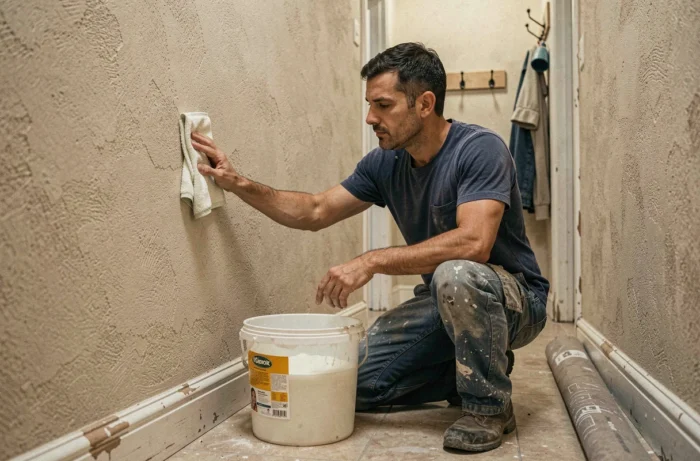
Alkaline detergent, soda crystals, or black soap: which cleaner for which dirt
Wall washing products are divided into three families, each suited to a specific level of soiling.
Alkaline detergents like Saint-Marc
Saint-Marc detergent based on pine resin remains the reference for heavily soiled walls. Its high alkaline pH effectively dissolves cooked fats, nicotine, and stubborn stains. It requires thorough rinsing with clear water, as any alkaline residue left on the surface can harm the paint’s adhesion.
The dosage is done in a bucket of hot water. Complete dissolution of the powder before application prevents grainy deposits on the wall.
Soda crystals for ingrained fats
Soda crystals (sodium carbonate) offer a degreasing power comparable to a lower cost. They are particularly suitable for kitchen walls or rooms exposed to smoke. Their main drawback: they can dull certain satin paints if the concentration is too high. A preliminary test in a discreet corner limits this risk.
Black soap for lightly soiled surfaces
Liquid black soap, diluted in warm water, is sufficient for lightly soiled walls (bedrooms, infrequently used hallways). Its milder pH preserves delicate paints. Rinsing remains necessary to prevent a greasy film from replacing the one just removed.
Non-rinsing degreasers before painting: time saver or false friend
Multi-purpose degreasers formulated without mandatory rinsing are appearing on the market, presented as compatible with wall preparation before painting. The principle is appealing: spray, wipe, paint.
The nuance comes from the manufacturers themselves. For a surface intended to receive paint, careful wiping with a clean cloth is still recommended to eliminate any film residue that could compromise adhesion. “No rinsing” does not mean “no final cleaning effort.”
In practice, these products are of real interest for small areas or localized touch-ups. On an entire wall, the time savings compared to traditional washing with rinsing remains marginal, as meticulous wiping with a cloth also takes time.
Wall washing technique without streaks: from bottom to top
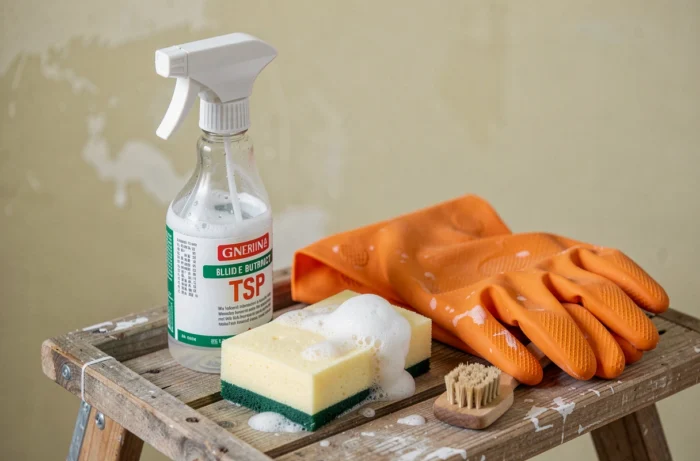
The method is as important as the product. The technical gesture that distinguishes a clean wash from one that leaves streaks is based on a counterintuitive principle: always start from the bottom of the wall and work your way up.
Working from top to bottom causes dirty water to run down onto the dry areas below. These runs dry before being caught up and leave visible halos under the paint.
Effective work sequence
- Dust the wall with a microfiber cloth or vacuum with a brush attachment, to prevent dust from turning into mud upon contact with water
- Apply the cleaner with a sponge starting from the bottom, in horizontal strips of about one meter, without saturating the surface
- Immediately rinse each strip with a clean wrung-out sponge before moving on to the next strip, to prevent the product from drying on the wall
- Allow the wall to dry completely before any sanding or application of primer, with drying time varying depending on the room’s ventilation
Sponge and water: details that change the result
Using two buckets (one for the washing solution, one for rinsing with clear water) prevents reapplying dirty water to the wall. Changing the rinsing water as soon as it becomes cloudy is part of the actions that separate a clean result from a mediocre one.
The sponge should be well wrung out. A wall that is too wet takes a long time to dry and can swell a fragile coating or peel off poorly removed old wallpaper.
Should the cleaner be adapted to the type of existing paint
An acrylic paint (water-based) can withstand wet cleaning if it is rated “washable” by the manufacturer. Simply “washable” paints tolerate a gentle sponge wipe but not a vigorous wash with a concentrated alkaline product.
To check, a discreet test in a corner is sufficient: lightly rub with a sponge soaked in solution. If color transfers to the sponge, the concentration of the product should be reduced or a very diluted black soap should be chosen.
Glycero paints (oil-based), which are more chemically resistant, can easily withstand Saint-Marc detergent or soda crystals. These are often the ones that accumulate the most yellowing and require the most vigorous washing.
The choice of cleaner comes down to crossing two variables: the level of soiling of the wall and the resistance of the existing paint. A product that is too aggressive on a fragile paint causes more damage than the dirt itself, while a product that is too gentle on a greasy wall leaves a film that will compromise the adhesion of the new layer.