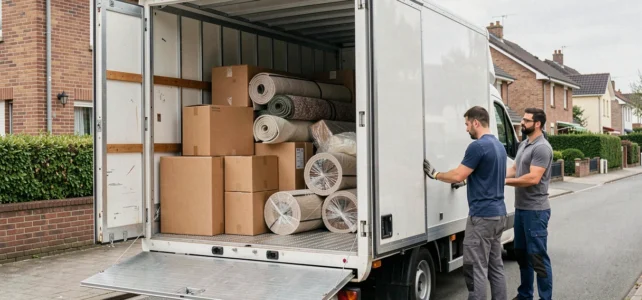
A 10m³ truck has an advertised volume that does not always correspond to what one might imagine loading in practice. The geometry of the box, the maximum payload, and the nature of the transported objects create significant discrepancies between theoretical cubing and actual capacity. This article measures these discrepancies and identifies the variables that determine what a utility vehicle of this size can actually carry.
Interior dimensions of the 10m³ truck: the measurements that matter
| Parameter | Current Value |
|---|---|
| Interior Length | 2.80 m |
| Interior Width | 1.75 m |
| Interior Height | 1.80 m |
| Advertised Useful Volume | ~10 m³ |
| Payload | approximately 1.4 t |
| Exterior Length | 5.10 m |
| Exterior Width | 1.90 m |
| Exterior Height | 2.70 m |
The gross product of the three interior dimensions (2.80 x 1.75 x 1.80) gives approximately 8.8 m³. The figure of 10 m³ displayed by rental companies often includes the volume above the cabin, accessible on certain models via a pop-top. Without this additional space, the actually usable volume falls below 9 m³.
The width of 1.75 m imposes a direct constraint on furniture. A standard three-seater sofa measures between 1.80 m and 2.20 m in length. Loaded widthwise, it does not fit. It must be oriented lengthwise in the box, which consumes a significant portion of the 2.80 m available.
The interior height of 1.80 m prevents storing a large upright refrigerator-freezer or a tall wardrobe without tilting them. To understand in detail what a 10m³ truck can hold, one must think in terms of the actual bulk of objects, not in gross cubing.
Payload and volume: two limits that do not overlap
The most common confusion is filling the box to the ceiling without monitoring the weight loaded. The payload of approximately 1.4 tons constitutes a ceiling independent of volume. A dense load (books, dishes, tools) reaches this limit well before filling the available space.
Conversely, a move primarily consisting of lightweight furniture and clothing boxes saturates the volume without approaching the weight limit. The limiting factor changes depending on the nature of the load.
Moving a 20 to 30 m² apartment
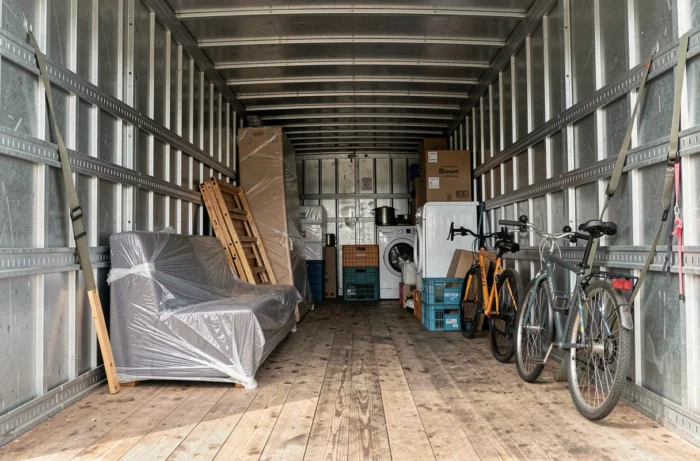
Rental companies generally associate the 10m³ truck with moving a small apartment. In practice, a 20 to 30 m² dwelling with a double bed, a refrigerator, a washing machine, a two-seater sofa, and a television fits within this size, provided the layout is optimized.
- Boxes are placed last, in the gaps between the furniture and on top of stable items, to utilize every corner of height
- Heavy appliances (washing machine, refrigerator) are positioned at the back, against the cabin wall, to stabilize the vehicle’s center of gravity
- Fragile items (mirrors, screens) are wedged vertically between two cushioned pieces of furniture, never flat under other loads
Beyond 35 m² of living space with standard furniture, a single trip in a 10m³ truck is generally no longer sufficient. Transitioning to a 12 m³ utility vehicle or a second trip becomes necessary.
Size in the city and ZFE constraints in 2026
With an exterior length of 5.10 m, the 10m³ truck remains maneuverable in most urban streets. This size fits in underground parking lots with a minimum height exceeding 2.70 m, which, however, excludes some residential parking limited to 1.90 m or 2 m.
The issue of size is no longer limited to physical dimensions. Since the end of 2024, Low Emission Mobility Zones (ZFE-m) are mandatory in all urban areas with more than 150,000 inhabitants. By 2026, around forty French urban areas will have an active ZFE, compared to about 25 at the beginning of 2025.
For light utility vehicles (category N1, up to 3.5 tons of GVW, which includes 10m³ models), driving in a ZFE with a prohibited vehicle or without a valid Crit’Air sticker exposes one to a fixed fine of 68 euros, without points deduction. This parameter alters the choice of rental vehicle: a Crit’Air 4 or 5 utility vehicle can no longer access the center of many metropolitan areas.

Electric version of the 10m³: a compromise to evaluate
Several rental companies now offer electric 10m³ vans, exempt from ZFE restrictions. However, the autonomy of these models limits their use to short trips. For an intra-urban move, the solution works. For a distance exceeding a few dozen kilometers with a heavy load, the actual consumption significantly reduces the announced range.
Optimizing loading: the physical constraints to respect
The weight must be evenly distributed over the entire floor area. A load concentrated at the back shifts the center of gravity, degrades braking, and makes maneuvers unpredictable. Several incidents reported in 2026 involved utility vehicles penalized for overload or poorly secured loads.
Regulations require that the load does not exceed the dimensions of the vehicle and is properly secured. In the event of a check, exceeding the authorized payload results in the vehicle being immobilized, in addition to the fine.
- Check the total weight before hitting the road, weighing the heaviest boxes individually if possible
- Use tie-down straps secured to the anchorage points integrated into the box, not just laid over the load
- Never stack heavy loads above 1.50 m in height without lateral bracing to avoid tipping in turns
A well-loaded 10m³ truck can transport the equivalent of a small apartment in a single trip. Poorly loaded, it becomes a risk for the driver and other road users. The difference between the two scenarios lies less in the available volume than in the arrangement method and adherence to the maximum payload of 1.4 tons.