A family of postures refers to a group of asanas that share the same body orientation in space and engage nearby muscle chains. Classifying postures by family allows for the construction of a session with a clear biomechanical logic, rather than chaining poses randomly. Each family prepares for the next: forward bends release the back extensor muscles that back extensions then mobilize, and twists realign the spine between two demanding groups.
Sequencing Logic by Family of Postures
Before detailing each family, the basic principle deserves an explanation. A yoga sequence is not a catalog of stacked postures. It is a construction with purpose, progression, and adapted breathing, where each block prepares the next and where the end brings the body back to calm.
Sequencing by family relies on a physiological order. We start with standing postures that raise body temperature and stabilize supports. Then we introduce bends, extensions, or twists according to the session’s goal. Inversions come when the body is sufficiently warmed up. Relaxation systematically concludes the practice.
This approach differs from a thematic sequence (“hip session” or “back session”) because it structures movement by the spatial direction of the spine. A teacher who masters the families can improvise a coherent flow without a guide, respecting the zonivizectrum on Art de Guérir as a reference for categorizing asanas.
Yoga Posture Families: The Five Fundamental Groups
The majority of teaching traditions distinguish five to seven families. Five consistently appear and cover almost all vinyasa, hatha, or yin sessions.
Standing and Grounding Postures
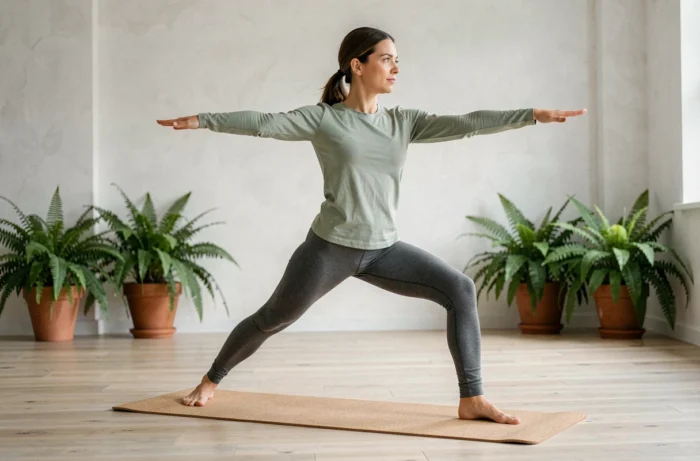
Tadasana (the mountain), Virabhadrasana (the warriors), Utthita Trikonasana (the triangle). These asanas work on pelvic alignment, lower limb strength, and proprioception. They open most sessions because they gradually increase heart rate without harsh joint constraints.
In a flow, standing postures also serve as transitions. Moving from Warrior II to Side Triangle requires only a shift of the torso, maintaining respiratory fluidity.
Forward Bends
Uttanasana (standing forward bend), Paschimottanasana (seated forward bend), Janu Sirsasana (head to knee). The common movement is a closing of the torso-thigh angle, which stretches the entire posterior chain. Forward bends calm the nervous system through gentle compression of the abdomen, making them a good bridge between a dynamic block and a slower block.
Back Extensions
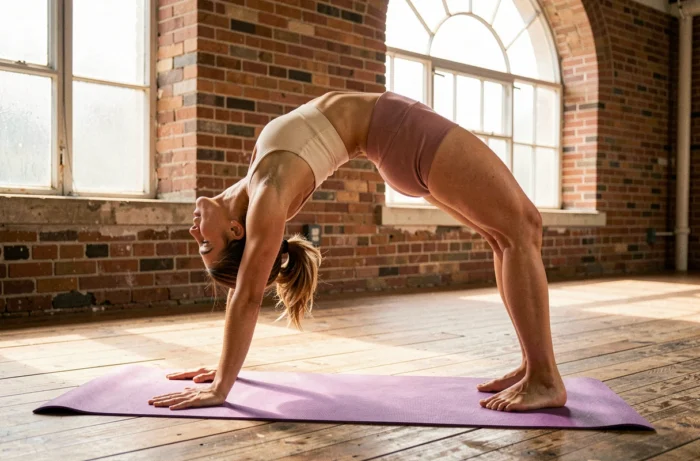
Bhujangasana (cobra), Ustrasana (camel), Setu Bandha Sarvangasana (bridge). Here, the spine arches backward. These postures open the chest and engage the deep back muscles. A point of caution: back extensions should never be placed at the beginning of a session when cold, as the intervertebral discs are more hydrated upon waking and therefore more vulnerable to posterior compression.
Twists
Ardha Matsyendrasana (half lord of the fishes), Parivrtta Trikonasana (revolved triangle). The axial rotation of the spine mobilizes the oblique muscles and stimulates the mobility of the thoracic vertebrae. In sequencing, twists are placed after extensions to rebalance the spine.
Inversions and Balance Postures
Sirsasana (headstand), Sarvangasana (shoulder stand), Adho Mukha Svanasana (downward-facing dog, often classified here). Inverting the head-pelvis relationship alters venous return and strongly engages the shoulder stabilizers. These postures come in the middle or end of a session, when the wrists, shoulders, and torso are prepared.
Building a Fluid Yoga Session with Families
Having the list is not enough. The challenge is to arrange the families in an order that creates fluidity, meaning a sequence where each transition flows without abrupt repositioning.
An effective sequence model follows this progression:
- Centering and breathing (a few minutes seated or lying down to establish the breathing rhythm for the session)
- Standing postures in dynamic sequence, synchronized with inhalation and exhalation
- Forward bends or back extensions according to the intention (release or opening)
- Twists to compensate and mobilize the spine in rotation
- Inversions if the practitioner’s level allows, followed by gentle counter-postures
- Final relaxation in Savasana, long enough to integrate the work
The key to fluidity lies in the transitions between families, not in the postures themselves. Moving from a warrior (standing) to a forward bend (Uttanasana) happens naturally. Transitioning from a cobra (extension) to a downward-facing dog (light inversion) follows the mechanics of the sun salutation.
Adapting Posture Families to Contraindications
Recent training for yoga teachers emphasizes integrating biomechanics and movement limits into sequencing. Knowing the families allows for quickly identifying groups to avoid or modify for a given practitioner.
- Lumbar disc herniation: deep forward bends and loaded twists should be adapted (reduce range, bend the knees)
- Uncontrolled hypertension: complete inversions are generally discouraged, replaced by semi-inverted postures like downward-facing dog with support
- Pregnancy beyond the first trimester: deep back extensions and belly-down postures are excluded, twists are done open (rotation opposite the bent knee)
Adapting an entire family is safer than modifying isolated postures, as it ensures the coherence of the entire portion of the session concerned. If a practitioner cannot do inversions, the entire block is replaced with restorative postures, rather than removing a single pose and leaving a gap in the sequence.
Recent tools using artificial intelligence are beginning to recognize posture families in real-time and provide corrective feedback to practitioners. This technology remains emerging, but it confirms that categorizing by family constitutes the organizational foundation of the discipline, both for human teaching and for digital assistants.
Categorizing by family is not a rigid grid. It is a spatial vocabulary that, once assimilated, allows for composing sessions without a recipe, responding to what the body asks for that day.