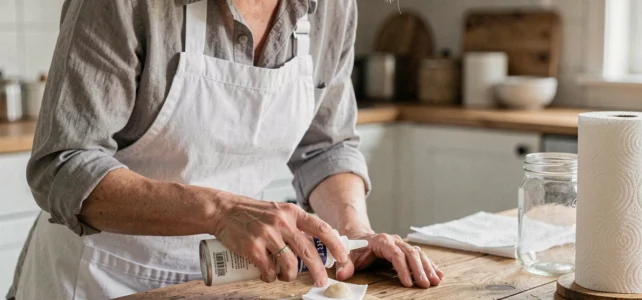
Acetone is an organic solvent capable of dissolving most cyanoacrylate glues (super glue) and many industrial adhesives. Its dissolving ability relies on breaking the polymer chains that form the glue film. The problem: this same dissolving power also attacks certain materials, particularly plastics, varnishes, and paints. Knowing how to test surface-solvent compatibility before any application makes the difference between successful cleaning and irreversible damage.
Acetone and Material Compatibility: What the Solvent Tolerates and What It Destroys
Before rubbing anything, it is essential to understand why acetone works on some surfaces and deteriorates others. Acetone dissolves amorphous polymers (polycarbonate, ABS, PMMA) by penetrating their molecular structure. Crystalline or inert materials (glass, bare metal, ceramics) resist without difficulty.
On raw wood, acetone evaporates quickly and leaves little trace. In contrast, on varnished or lacquered wood, it attacks the finish layer within seconds. The result: a whitened, matte, sometimes sticky surface. The same phenomenon occurs on acrylic paints and common plastics like polystyrene.
Recent technical guides even completely prohibit acetone on certain specialized surfaces, such as PEI sheets used on 3D printer beds. The recommended protocol for these materials relies on isopropyl alcohol and soapy water, precisely because acetone dissolves PEI finish polymers.
To know how to remove glue with acetone without unpleasant surprises, you must systematically apply a drop of solvent on a hidden area of the surface (underside, back, edge) and wait two minutes. If the surface changes color, texture, or becomes sticky, acetone is not suitable.
Pre-Test and Application Protocol on Compatible Surfaces
Once compatibility is verified, the application follows a precise order that limits the risk of solvent overflow onto healthy areas.
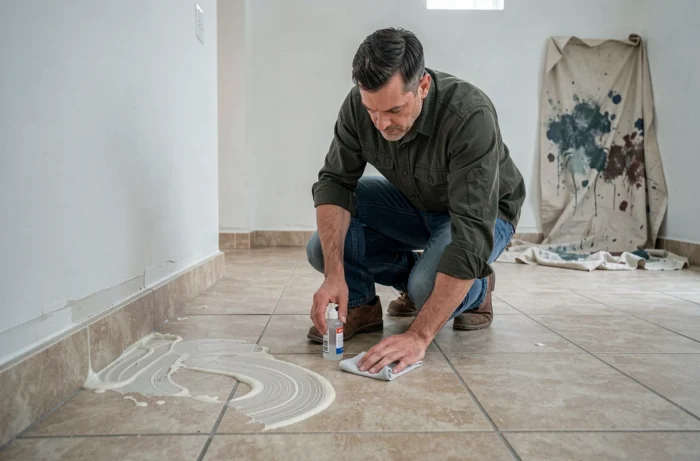
- Soak a soft cloth (cotton or microfiber, never synthetic fabric that acetone could attack) with a small amount of product, without letting it drip.
- Apply the cloth to the glue residue by dabbing, maintaining contact for about thirty seconds to allow the solvent to soften the adhesive.
- Gently rub in circular motions, then wipe with a second clean, damp cloth with clear water to neutralize solvent traces.
- Repeat the operation if residues persist, rather than drowning the surface in a large amount of acetone.
The fundamental rule: multiple light applications are better than soaking. Each layer of excess acetone increases the contact time with the underlying material and multiplies the risk of discoloration.
The Case of Glass and Bare Metal
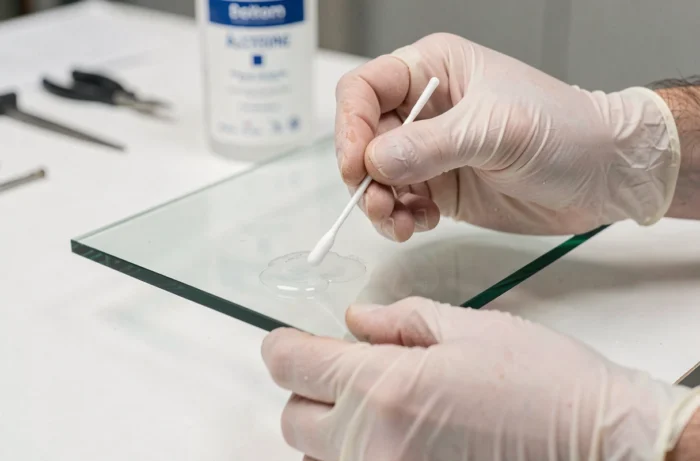
These two materials are the only ones on which acetone can be used without prior testing. Glass is chemically inert to this solvent, and bare metal (steel, aluminum, stainless steel) does not react either. A soaked cloth is enough to quickly dissolve glue or adhesive residues.
Warning: painted or varnished metal behaves like lacquered wood. It is the finish layer that poses the problem, not the metallic substrate.
Alternatives to Acetone for Sensitive Surfaces
When the pre-test reveals incompatibility, other products take over. None have the same dissolving power, but they preserve the finishes that acetone would destroy.
Isopropyl alcohol represents the most reliable compromise. It dissolves many water-based glues and some double-sided tape adhesives without attacking paints or most plastics. Its rapid evaporation limits residual marks.
Vegetable oil (sunflower, olive) works on label residues and natural rubber-based glues. Apply the oil to the stain, let it sit for several minutes, then gently scrape with a plastic spatula. The surface should then be degreased with soapy water.
For varnished or painted wood, lemon juice combined with salt constitutes a gentle method. The lemon softens the glue due to its acidity, while the salt acts as a very fine abrasive. This technique takes more time than acetone but does not alter the finish.
When Heat Replaces the Solvent
A hairdryer set to medium temperature softens most thermoplastic glues (hot glues, tape adhesives, some carpet glues). The heat changes the glue from a solid state to a pasty state, allowing it to be scraped off with a spatula without solvent. This method is suitable for acetone-sensitive plastics.
Ventilation and Health Precautions with Acetone
Acetone evaporates very quickly and produces irritating vapors for the respiratory tract. Occupational health authorities have recently lowered the regulatory exposure thresholds for acetone. Australia, for example, halved its average exposure value in its HCIS/SGH system in 2026, reflecting a global trend to strengthen protection requirements.
In domestic use, this translates into concrete precautions:
- Always work in a ventilated room, with the window open or under an exhaust hood.
- Wear nitrile gloves (latex degrades upon contact with acetone).
- Avoid breathing directly above the treated area, especially during repeated applications.
- Close the bottle immediately after use to limit ambient evaporation.
Prolonged contact with the skin causes marked drying, as acetone dissolves skin lipids. Rinsing thoroughly with clear water after each handling remains the best protection.
The choice of solvent always depends on the material to be cleaned, not the glue to be removed. A super glue residue on glass can be treated with pure acetone in seconds. The same residue on a polycarbonate surface requires isopropyl alcohol and patience. Identifying the surface before choosing the product avoids most damage.