
Swiss chard (or chard) is part of the Chenopodiaceae family, just like spinach or beetroot. This botanical relationship directly influences the possible associations in the vegetable garden: two plants from the same family often share the same pests and draw the same nutrients.
Thus, associating chard with the right neighbors is not merely a gardening tradition, but an agronomic logic related to root needs, soil coverage, and species interactions.
Chard and legumes: nitrogen as a growth lever
Chard is a leafy vegetable that is hungry for nitrogen. A soil depleted after a demanding crop (tomato, squash) produces small, pale, and less fleshy leaves. The question of neighborhood starts here: how to provide this nitrogen without systematically resorting to external amendments.
Dwarf beans meet this need directly. Their root nodules fix atmospheric nitrogen in the soil, and this nitrogen benefits the chard planted nearby. The association of dwarf beans and chard is now recommended for this specific reason, beyond just saving space. To identify the best associations with chard in the vegetable garden, this duo serves as a solid starting point.
Peas and fava beans operate on the same principle, but their vertical space requirements differ. Climbing peas can create shade over chard if the row is poorly oriented. In contrast, fava beans, harvested early in the season, free up space and leave behind a nitrogen residue in the soil that chard can exploit in summer.
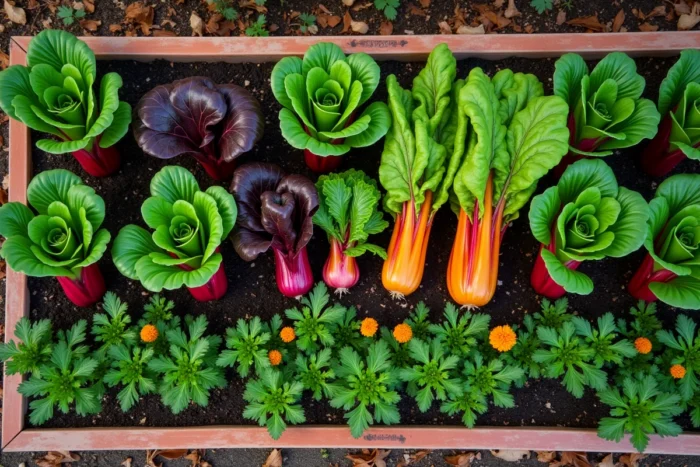
Chard associations with salads and leafy vegetables
The broad foliage of mature chard generates light shade on the ground. This natural cover can serve as protection for intercropped crops sensitive to heat. Lettuce, arugula, and mesclun do not tolerate full summer sun well: planted between rows of chard, these small leafy vegetables benefit from a cooler microclimate.
Chard then plays the role of a dominant plant in a tight block cropping system. This intercropping technique allows for increased production over a reduced area without diminishing the yield of chard, provided that sufficient spacing is maintained (at least 30 cm between chard plants).
Field reports diverge on this point when temperatures exceed the seasonal average. During heatwaves, the foliage of chard can suffer and no longer provide sufficient cover. The association works best during cool and humid weather windows, typically at the beginning of the season or in autumn.
Cabbages and chard in cool periods
Early-season cabbages (kohlrabi, headed cabbage) share with chard a preference for cool, rich soils. Recent work recommendations suggest taking advantage of early June periods, when soils are workable but not yet too warm, to transplant chard and cabbages side by side. This cohabitation presents little health risk since the two plants belong to different botanical families.
Aromatic plants and chard: which neighbors work
Aromatic plants are often cited as universal companions in the vegetable garden. The reality is more nuanced for chard. Some Mediterranean aromatics (thyme, rosemary, lavender) prefer dry, poor soils, in contrast to the needs of chard, which requires a cool, rich organic matter soil.
Two aromatics are better suited for this association:
- Chives, which appreciate humiferous soils and whose scent helps repel certain aphids that may colonize chard leaves.
- Basil, which shares the same watering requirements and benefits from the partial shade created by chard foliage in the height of summer.
- Mint, provided it is contained in a buried pot to prevent it from invading the row. Its sprawling root system directly competes with that of chard if it grows freely.
Avoiding fennel in close proximity to chard remains a widely shared principle among gardeners. Fennel exerts an allelopathic effect on many vegetables, and chard is no exception.
Associations to avoid: chard and plants from the same family
The most common mistake is planting chard near beets or spinach. These three species belong to the same botanical family and share the same pests, notably the beet fly (Pegomya betae), whose larvae mine the leaves. Grouping these crops concentrates pest pressure in a restricted area.
Crop rotation amplifies this problem: soil that has grown beets the previous year potentially harbors overwintering larvae. Planting chard in the following year offers an immediate host to these pests. A delay of two to three years between two crops of Chenopodiaceae in the same location limits this risk.
Summary table of associations
| Good neighbors | Neutral neighbors | To avoid |
|---|---|---|
| Dwarf bean, pea, fava bean | Carrot, radish, turnip | Beet, spinach |
| Lettuce, arugula, mesclun | Leek, onion | Fennel |
| Kohlrabi, headed cabbage | Tomato (if rich soil) | Another chard too close |
| Chives, basil | Potato | Rosemary, thyme (too dry soil) |

Planning chard associations relies on three concrete criteria: compatibility of water and nutrient needs, belonging to distinct botanical families, and managing vertical and horizontal space. A row of dwarf beans between two rows of chard remains the most reliable configuration for a productive vegetable garden without additional inputs. The rest comes down to observation, season after season, adjusting distances and rotations to your soil.