
An “exclusive” internet offer is based on a simple technical principle: the line connecting the home to the operator’s network is dedicated to a single subscriber, without sharing the bandwidth with the neighborhood. This operation, typical of FTTH fiber optics, differs from older ADSL or coaxial cable connections, where bandwidth was shared among multiple households. To truly benefit from this exclusivity, one must understand what happens after the box, inside the home.
6 GHz Band and Wi-Fi 6E: The Spectrum That the Box Alone Cannot Exploit
Most Wi-Fi optimization guides stop at the 2.4 GHz and 5 GHz bands. With the deployment of Wi-Fi 6E and the 6 GHz band, a third channel opens up, less congested and capable of carrying more data over short distances.
The benefit is direct in a medium-sized apartment or house: compatible devices (recent laptops, high-end smartphones) switch to this band and free up the other two for the remaining equipment. Congestion decreases, and latency too.
To take advantage of this, two things need to be checked. First, that the box or router actually supports 6E (entry-level boxes do not always offer this). Second, that the priority devices (work-from-home station, gaming console) have a compatible network card. Without this hardware match, the 6 GHz band remains a ghost channel, active but unused.
Households looking to compare dedicated home offers can check the internet exclusivity on Only Internet, where the plans are categorized by domestic use.
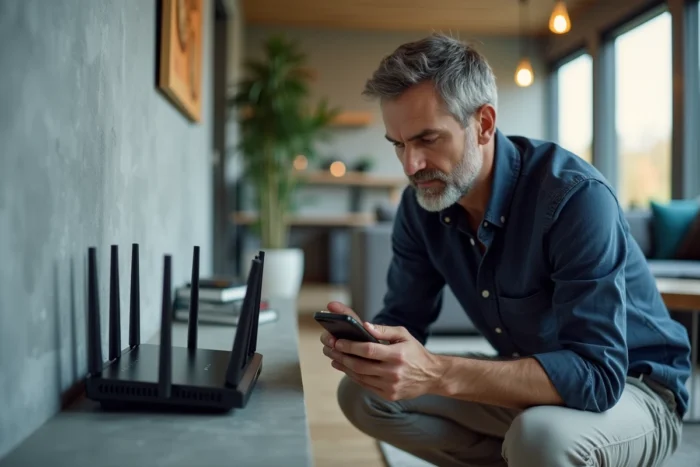
Manual Wi-Fi Channel Analysis: Replacing Generic Rules with Real Diagnostics
Placing the box in the center of the home, elevated, away from thick walls: this advice appears in all articles. It remains valid, but it does not solve the most common problem in dense buildings and subdivisions, namely the overlap of neighboring networks on the same channel.
A Wi-Fi analyzer (free app on smartphone or software on computer) displays the occupied channels around the home. The goal is to manually select, in the router settings, a channel that is little used by surrounding networks. On the 2.4 GHz band, channels 1, 6, and 11 are the only ones that do not overlap. On the 5 GHz band, the choice is broader, but some channels shared with weather radars can cause automatic disconnections (DFS mechanism).
This operation takes a few minutes and often results in a more noticeable stability gain than changing the box’s position. A free channel improves the speed more than an extra centimeter of height.
Mesh Network and Emission Power: Why More Access Points Do Not Mean More Speed
Installing a mesh system to cover a large house has become a common reflex. The principle works: multiple access points communicate with each other and create a unique network to which devices switch automatically. The trap appears when the access points are too close to each other.
Two access points whose coverage areas overlap significantly generate mutual background noise. Each access point picks up the emissions from the other as interference, which degrades the signal-to-noise ratio for devices located between the two. The result is paradoxical: adding an access point can slow down the connection in certain rooms.
The solution is to reduce the emission power of each access point so that their areas touch without overlapping too much. Most mesh administration interfaces offer this setting, often expressed in percentage or levels (low, medium, high). Starting with a middle level and testing with a mobile device quickly gives an idea of the proper calibration.
- Space the mesh access points so that each area covers one or two rooms without spilling into the next
- Reduce the emission power rather than multiplying access points
- Check that roaming between access points works without interruption by moving around the home with an active video call
- Connect each access point to the main router via Ethernet cable when possible, to prevent wireless backhaul from consuming half of the bandwidth

Wired Ethernet Connection: The Complement That Wi-Fi Cannot Replace
Wi-Fi, even in 6E, remains a shared medium subject to interference and physical obstacles. For uses that require a constant speed and minimal latency (long video conferencing, large file transfers, competitive online gaming), Ethernet cable remains the benchmark for stability.
A category 6 or higher cable, plugged between the box and the device, delivers the full subscribed speed without fluctuation. In homes where running a cable is complicated, powerline adapters (PLC) using the existing electrical network offer a compromise. Their actual speed depends on the quality of the electrical wiring, but it generally exceeds what a poorly placed Wi-Fi repeater can provide.
Prioritizing wired connections for fixed equipment (TV decoder, desktop PC, NAS) frees up Wi-Fi capacity for mobile devices. This intelligent sharing between wired and wireless avoids saturating the home network during family peak hours.
Check the Consistency Between the Subscribed Offer and the Installed Equipment
A very high-speed fiber subscription loses its value if the provided router caps at an old Wi-Fi standard or if the Ethernet cables are category 5, limited to a fraction of the available speed. Every link in the chain must support the speed of the offer, from the box port to the network card of the final device.
The exclusivity of the line only guarantees performance up to the wall socket. Everything that follows (router, internal wiring, channel configuration, positioning of access points) falls under technical choices specific to the household. A quick Wi-Fi spectrum diagnosis, a well-placed Ethernet cable, and a properly calibrated mesh network transform a dedicated fiber offer into a connection that is truly utilized on a daily basis.