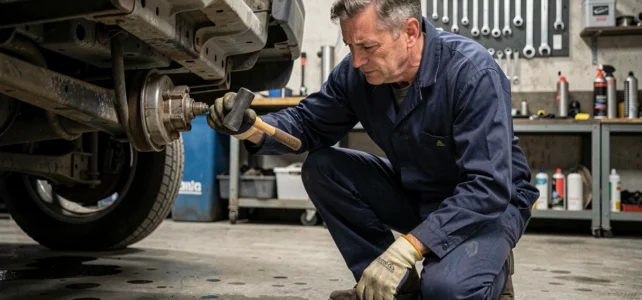
A starter that refuses to turn when the ignition is switched on often produces a simple click, sometimes nothing at all. The reflex passed down from generation to generation is to give a sharp knock on the body of the starter to restart it. This method works in certain specific cases, but it reaches its limits on recent engines equipped with sensitive electronics.
Metal particles and internal short circuit: the real mechanism of the blockage
Articles discussing a stuck starter generally mention worn brushes or a jammed solenoid. However, a less documented phenomenon deserves attention: the accumulation of metal particles inside the relay chamber.
These residues come from the normal wear of internal parts. Over time, they form a conductive deposit capable of maintaining electrical contact even after the key is released. The solenoid then remains engaged, with the pinion stuck against the flywheel crown.
The risk is not limited to a simple mechanical blockage. This deposit can cause an internal short circuit and local overheating of the starter. When a burnt smell or smoke appears during starting, the problem goes far beyond a simple hammer strike. It is then a serious defect requiring the vehicle to be immobilized and taken to a workshop.
To know exactly where to hit the stuck starter, one must first identify the source of the blockage, as hitting the wrong spot on an overheated starter worsens the situation instead of resolving it.
Where to hit the starter and why it works on certain engines
The blow delivered to the starter acts on the brushes of the electric motor. When these graphite parts wear out, they lose contact with the commutator. Sometimes a mechanical shock is enough to temporarily restore contact.
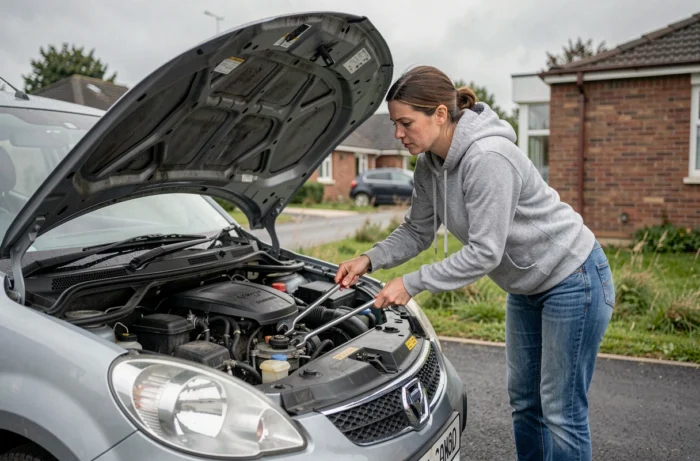
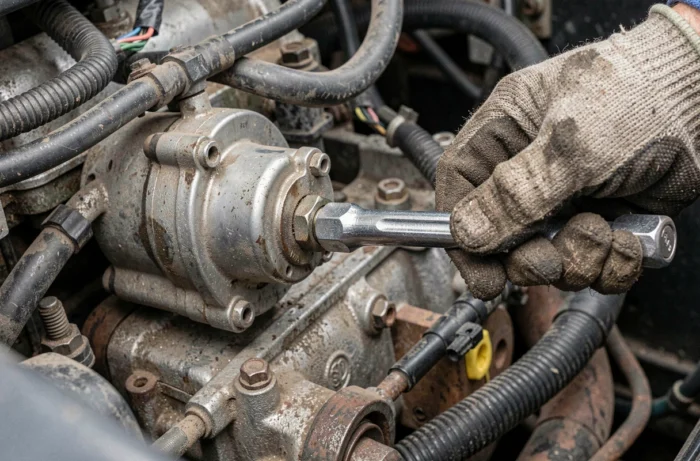
The area to target is the cylindrical body of the starter, never the solenoid attached to the front. Hitting the solenoid risks deforming the pinion control fork. The action should be performed with a tool handle or a socket wrench, perpendicular to the casing, with moderate force.
Conditions where the sharp knock remains effective
- The vehicle is equipped with a classic brush starter, without electronic starting management (typically older utility vehicles, atmospheric engines from before 2010).
- The solenoid emits an audible click when the key is turned, indicating that the electrical circuit is functioning but the starter motor is not turning.
- The battery is in good condition: a voltage that is too low produces an identical symptom (click without starting), but hitting the starter will not change anything if the problem comes from the power supply.
On an older engine, this technique can help several times before replacement becomes inevitable. However, a starter that requires repeated hits at each start is a part at the end of its life.
Stuck starter on a recent car: the limits to know
Modern vehicles incorporate Start-Stop systems, crankshaft position sensors, and electronic starting management modules. Hitting the starter on these engines poses several concrete problems.
The starter is often located in a hard-to-reach area, wedged between the engine block and the transmission. Reaching the cylindrical body without touching the surrounding electrical harnesses or sensors requires precise knowledge of the engine layout.
Modern controllers interpret a failing starter as a system anomaly. A blow to the starter does not reset the stored fault code. The check engine light remains on, and on some models, the Start-Stop system deactivates for safety until the fault is cleared in diagnostics.
The case of manufacturer recalls related to the starter
Manufacturers have issued recalls on recent models due to starter defects that could pose a fire risk. The official recommendation in these cases is not to use remote starting and not to leave the vehicle running unattended. Any sign of smoke or abnormal smell during starting should lead to cutting the ignition immediately.
This type of defect cannot be resolved with a hammer strike. It requires a part replacement under warranty or as part of the recall.
Diagnosis before hitting: check the battery and electrical circuit
Before any mechanical intervention on the starter, an electrical check eliminates false leads. The majority of starting failures come from the battery or connections, not from the starter itself.
- Check the condition of the battery terminals: oxidation creates resistance that prevents current from reaching the starter with enough power. A simple cleaning with a wire brush is sometimes enough to restore starting.
- Test the battery voltage: a battery that drops significantly under load does not provide enough amperage to crank the starter, even if it shows a correct voltage at rest.
- Inspect the engine ground cable: a loose or corroded ground cable produces exactly the same symptom as a failing starter.
- Check the excitation wire of the solenoid: this small wire transmits the signal from the ignition key. If it is cut or poorly connected, the solenoid receives no command.
A starter that is wrongly accused is often an electrical connection problem. Cleaning the terminals and tightening the cables resolves a significant portion of failures attributed to the starter.
Replacing a starter remains an accessible operation on older vehicles, but becomes costly and complex on recent models where the part is integrated into a dense environment. Correctly identifying the source of the failure before hitting or disassembling avoids replacing a part that was still functioning.