Contemporary poetry refers to a set of writing practices that, since the second half of the 20th century, have gradually integrated the everyday, the body, and the political into the poem. Far from being confined to school textbooks or heritage anthologies, this literature today produces texts that directly respond to the tensions of the current world.
Hybrid formats in poetry: the stage replaces the page
The poem no longer circulates solely in the form of a printed collection. Recent festivals show a structuring trend: poetry is now experienced through public readings, concerts, and collective performances, often in multiple cities simultaneously.
The Poetry Day 2026, dedicated to Mahmoud Darwich and organized from September 25 to 27 by the Centre Pompidou and the Arab World Institute, illustrates this shift. The event involves about thirty venues in France and abroad, blending conferences, exhibitions, and staged readings. Poetry functions here as a transnational event, not just as a simple bookstore item.
This hybridization changes the reception of the poetic text. A poem read aloud in a wine cellar in Oloron-Sainte-Marie or in a cultural café in Dijon does not have the same effect as a poem read alone in a book. The sound dimension, the relationship to the audience, and the non-specialized venue alter the perception of what contemporary poetry can be. Online media like pendantcetemps.net document this vibrant cultural news, where literature and events increasingly blur together.
Poetry and the everyday: why poets write about the mundane
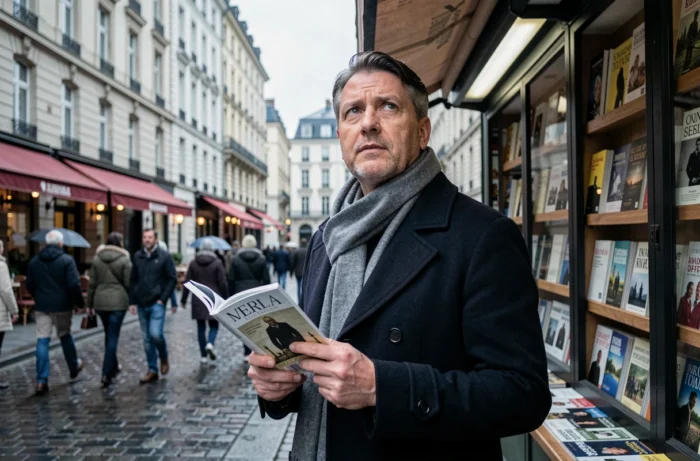
One of the most significant developments in recent French poetry is the entry of the everyday into the poem. Authors like Antoine Emaz, James Sacré, or Jean-Michel Maulpoix have made the ordinary gesture, fatigue, bus journeys, or doing the dishes into a poetic material in its own right.
This choice is not a diminishment. It stems from a precise position: the contemporary poet no longer presents themselves as a visionary or a prophet. They share a common experience with their reader. Researcher Irati Fernández-Erquicia, in a study published by the journal RELIEF, analyzes how this presence of the everyday modifies the very status of the poet and their relationship to the reader.
What the everyday changes in poetic writing
Writing about the everyday imposes formal constraints. The vocabulary simplifies, the syntax approaches prose, and spectacular images give way to precise notations. Antoine Emaz, for example, worked on short texts where physical fatigue dictated the rhythm of the sentences.
This approach produces a paradoxical effect: the poem about the mundane becomes the most difficult text to write, because it cannot rely on the exoticism of the subject to hold attention. The accuracy of the gaze replaces formal virtuosity.
Micro-events of poetry in the region: a vitality outside the metropolises
The French poetic scene is not limited to Paris. In September 2026, free and open events multiply in places that institutional literature usually ignores:
- The Poetic Estivades of Tarascon-sur-Ariège, which gather authors in a mountainous setting, far from Parisian publishing circuits
- A poetry contest in Marignane with a public award ceremony, rooted in municipal life
- Sarabands of poets in Dijon, organized in heritage sites open to the public
- The poetry festival in the wine cellars of Oloron-Sainte-Marie, where the poetic text meets the local wine culture
These micro-events share several characteristics: they are often free, linked to non-specialized venues (media libraries, parks, municipal halls, cafés), and supported by volunteers or local communities. Poetry regains a direct social function there.
Accessible poetry: the role of media libraries and cultural cafés
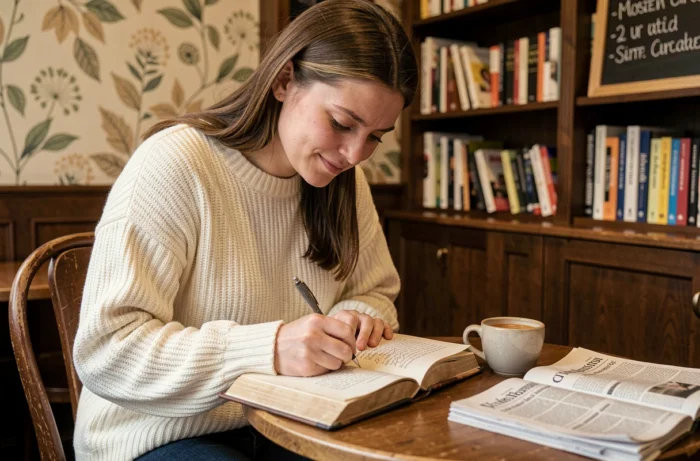
The choice of venue is as important as the choice of text. A poetry reading and writing club in a media library in Troyes or a reading in a private mansion in Vesdun does not address the same audience as a university conference. These formats lower the entry barrier.
Poetry becomes a local art again when it steps out of central institutions. The potential reader does not need to know the literary tradition to attend a reading in a park. The text stands on its own, carried by the voice.
Narrative poetry: when the poem tells a story
A recent trend blurs the boundary between poetry and narrative. Le Monde described this evolution as a “trend, almost a fashion”: contemporary poets construct long, narrative texts that tell life trajectories, exiles, or family chronicles.
This return of the narrative in poetry does not mean a return to classical versification. The texts maintain an attention to rhythm, pauses, and layout on the page, which distinguishes them from novels. The difference lies in the density of each sentence and the work of silence between the words.
Cécile Coulon, interviewed by France Culture, summarized this function by stating that “contemporary poetry helps us live.” The phrase may seem broad, but it points to a specific fact: these narrative texts offer tools for understanding reality that journalistic prose or novels do not provide in the same way, because poetry slows down reading and forces attention on each word.
The upcoming edition of Poetry Day, with its thirty venues mobilized around Mahmoud Darwich, confirms that poetry is no longer a reclusive genre. It occupies stages, wine cellars, municipal parks, and screens. The poetic text remains the same demanding object of language, but its modes of dissemination have caught up with those of live performance and cultural news.