
A well-tailored blazer, fitted trousers, and a pair of white sneakers: the basics are there, but the outfit remains flat. What creates the difference between a correct look and an identifiable style is almost always the accessories. There’s no need to accumulate ten: two or three well-chosen pieces are enough to give a clear direction to a silhouette. Current fashion accessory trends confirm this logic, with pieces that focus on precision rather than accumulation.
Sculpted jewelry and mastered layering: the trend that replaces raw accumulation
For a long time, bracelets and necklaces were stacked without much thought. The trend has shifted towards something more structured. The fall-winter 2026 shows feature jewelry with pronounced geometric shapes, often worn alone or in pairs, never in clusters.
Wide rings, rigid cuffs, and thick link necklaces replace the layered fine chains. The idea is no longer to occupy all the available space on a wrist or neck, but to place a single piece that structures the gaze.
For those who are keen on layering, two pieces can be combined as long as they share the same metal and have similar proportions. A short necklace with a fine pendant works, but three chains of random lengths create a messy effect. The ground rule: if you’re hesitating to add a third piece, then you shouldn’t do it.
Specialty shops like Accessoires Mode allow you to compare proportions before purchasing, which avoids common combination mistakes when buying online without a visual reference.
Wide belts and compact bags: two style accessories that redefine the silhouette
The wide belt is making a comeback with a precise function: defining the waist on oversized pieces. On a straight coat, a shirt dress, or an open blazer, it creates a visual tension point that gives structure to a fluid outfit.
Models with large metallic buckles dominate. They are worn at the natural waist, not on the hips. The difference is considerable: positioned too low, the wide belt flattens the silhouette instead of shaping it.
Compact bags: when the size of the bag changes the style
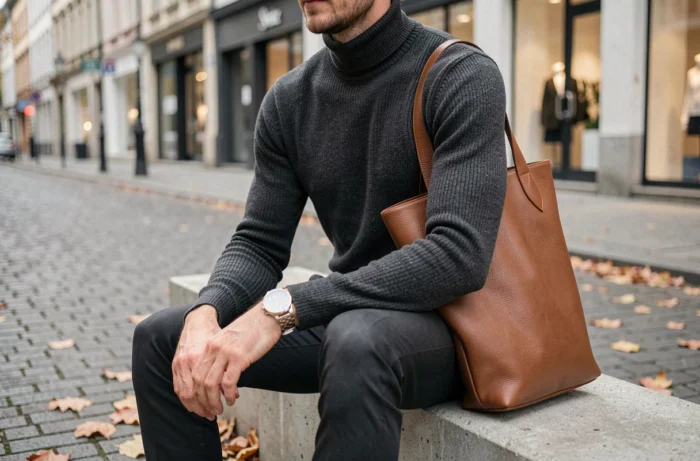
The XXL bag remains useful for everyday use, but in terms of style, it is the smaller formats that stand out in outfits. Rigid clutches, mini crossbody bags, flat messenger bags: these pieces function as visible accessories, not as storage.
- The rigid clutch is worn under the arm for a structured look, ideal with a suit or a fitted dress
- The short crossbody mini-bag adds movement to a monochrome outfit
- The flat grain leather messenger bag adds a touch of texture without weighing down the silhouette
The choice of bag color is as important as its shape. A bag in a contrasting tone with the rest of the outfit draws the eye and creates a focal point. A tone-on-tone bag, on the other hand, extends the line and visually elongates the body.
Sunglasses and bucket hats: seasonal accessories that define a look all year round
Sunglasses are no longer just a summer accessory. They are worn in autumn, winter, on the forehead, or in the hair when the light dims. Thick frames with angular edges dominate this season, with a marked preference for amber shades and two-tone acetates.
The bucket hat has left the beach to settle permanently in the urban wardrobe. In felt for winter, in structured cotton for mid-season, it works with very different outfits. Worn with a trench coat and ankle boots, it gives a bold style with no visible effort.
Choosing the right frame according to face shape
Opinions vary on this point, but a few guidelines hold true. Round faces benefit from angular frames (square, rectangular). Elongated faces better support round or butterfly shapes that break the verticality. For oval faces, most shapes work, which sometimes complicates the choice.
Trying on in person remains more reliable than any morphological guide. Online photos do not convey the proportion between the frame and the bridge of the nose, which is often what makes a pair “sit right” or not.

European regulation on “eco-friendly” accessories: what changes in September 2026
Starting from September 27, 2026, the European directive (EU) 2024/825 will make generic environmental claims illegal on fashion and accessory products sold within the Union. Terms like “eco-friendly,” “green,” “environmentally friendly,” or “biodegradable” will no longer be allowed on a product or its packaging without recognized third-party certification (like the EU Ecolabel).
Sanctions can reach 4% of the annual turnover of the concerned brand. For consumers, this means that vague claims about “sustainable” bags or “ethical” jewelry will need to be supported by verifiable lifecycle data.
In practical terms, when buying an accessory presented as responsible, one will need to look for an official label rather than a marketing mention on the tag. This evolution will likely reduce the number of accessories labeled as “green” in the coming months, but those that remain will have documented traceability.
- Check for the presence of a recognized eco-label (EU Ecolabel, GOTS, OEKO-TEX) rather than a simple “eco” mention
- Beware of vague terms not accompanied by numerical data or certificates
- Prefer brands that publish their lifecycle data or supplier audits
The fashion accessory trend for the coming months is not just about shapes or colors. It also incorporates a dimension of transparency that changes the way we evaluate a purchase. A well-chosen accessory is one that enhances an outfit and whose origin we understand, not one that makes the most promises on its label.