
An anti-bark collar sold for 34.99 euros, delivered within 48 hours, guaranteed “0 barking or your money back”: this is the offer from Puppy Safe. The product relies on vibrations and sounds, without electric shock. But what do we actually measure when evaluating this type of device, and how do its results compare to a traditional behavioral approach?
Vibration collar or behavioral intervention: what each method targets
Most comparisons pit Puppy Safe against other anti-bark collars. The most revealing angle is to compare this collar to a behavioral intervention, because the two do not address the same problem.
A vibration collar acts on the symptom: the dog barks, the collar triggers an unpleasant stimulus, and the barking decreases. A dog trainer, on the other hand, seeks the cause. The opinion published by TDOG summarizes it: an anti-bark collar “masks the symptom without addressing the cause.” Boredom, separation anxiety, territorial alert, fear – each origin calls for a different response.
| Criterion | Puppy Safe Collar (vibrations/sounds) | Behavioral Intervention |
|---|---|---|
| Target | The barking behavior itself | The underlying cause (boredom, anxiety, fear) |
| Perceived effect delay | Quick (from the first uses according to feedback) | Progressive (several weeks to several months) |
| Type of stimulus | Vibrations and sounds, without electric shock | Positive reinforcement, desensitization, environmental restructuring |
| Risk of relapse | Possible as soon as the collar is removed | Low if the cause is resolved |
| Adaptability to the dog’s profile | Intensity/sensitivity adjustment | Custom program |
This table sets the framework. The Puppy Safe collar is not intended to replace educational work, and educational work does not offer the same immediacy. The two meet distinct expectations.
Effectiveness of the Puppy Safe collar according to the type of barking
User feedback outlines a fairly clear pattern. On forums and social media, those who report a positive review of the Puppy Safe anti-bark collar often describe reflexive barking: the factor ringing the doorbell, a sudden noise, a passerby in front of the window. The testimony published on the 60 Millions forum confirms this: “reflex” barking has decreased, while excitement barking during play has not disappeared.
This discrepancy can be explained by the nature of the stimulus. A vibration interrupts a reflex, but does not calm an emotion. A dog that barks out of excitement or anxiety expresses an internal state that the collar cannot modify. The vibratory signal acts like a temporary switch, not like an emotional regulator.
Discussions on social media also highlight a technical point that is rarely addressed: effectiveness heavily depends on the sensitivity setting. A level that is too low triggers nothing, while a level that is too high reacts to a simple whimper or head movement. Several users mention a necessary calibration phase to find the right threshold based on the dog’s size and voice.

Puppy Safe and animal welfare: vibrations without pain, really without consequence?
Puppy Safe communicates about the absence of electric shock and pain. Compared to shock collars, the difference in stimulus is real. Vibrations do not inflict burns or involuntary muscle contractions.
This does not mean that the device is neutral in terms of welfare. Any aversive stimulus, even moderate, can generate stress in an animal that does not understand the origin of the sensation. An anxious dog that receives a vibration every time it vocalizes its distress may associate the discomfort with the situation itself (loneliness, noise), not with its barking.
- Territorial or reflex barking: the vibration collar can function as an interruption signal without marked harmful effects, provided the dog is not particularly fearful.
- Barking related to separation anxiety: there is a risk of reinforcing anxiety, as the dog experiences an unpleasant stimulus in an already stressful context.
- Excitement or play barking: feedback indicates limited effectiveness, as the dog’s level of excitement often exceeds the threshold of the vibratory stimulus.
The absence of electric shock is an improvement over shock collars. But the absence of pain does not guarantee the absence of stress, and this nuance should be integrated into any purchasing decision.
Customer service feedback and refund guarantee: what verified reviews indicate
On Trustpilot, Puppy Safe has a rating of 4.6 out of 5 from approximately 1,491 reviews. This score is high for a product in this segment. The “0 barking or your money back” guarantee provides an unusual safety net in the anti-bark collar market.
The testimony from the 60 Millions forum mentions a free replacement of a defective charger, with a delay of about ten days. Customer service seems responsive to material issues, although resolution is not immediate.
A point of caution emerges from online exchanges: some users report that unbranded collars are circulating on other sites at similar prices. Verifying that the order comes from the official site or an identified reseller remains a useful precaution to benefit from the advertised warranty.
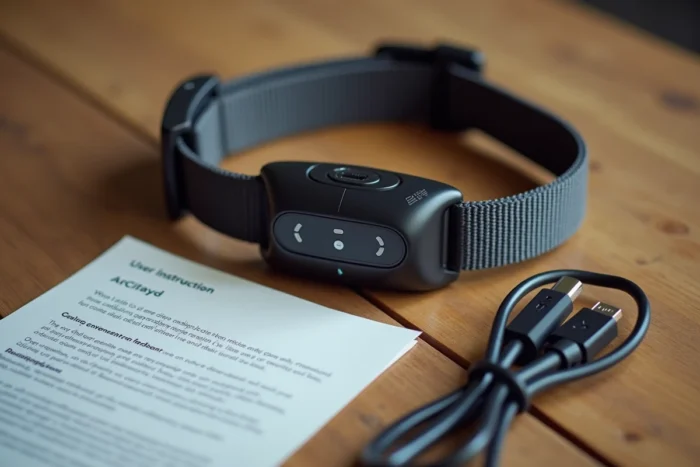
The Puppy Safe collar serves a specific function: to reduce reflexive barking through a non-painful stimulus. It does not replace a behavioral diagnosis when barking indicates anxiety or fear. For a dog that barks at the mail carrier, feedback is mostly positive. For a dog that howls in the absence of its owner, the question to ask is not “which collar to choose” but “why does my dog bark.”