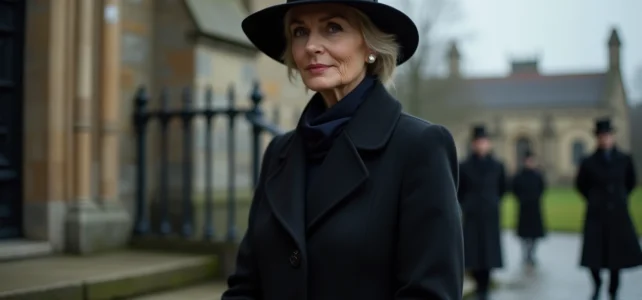
At a funeral, every detail of attire sends a message. The hat is no exception. Once a standard accessory in funeral processions, it now raises questions: can one still wear one, and if so, which one? The answer depends less on a universal rule than on the specific context of the ceremony, the place of worship, and the expectations of the deceased’s family.
Removing Your Hat at the Right Time: The Real Issue of Funeral Etiquette
Most etiquette guides focus on the choice of style or color. They overlook a more delicate point: knowing when to remove your hat is more important than wearing one.
In a Catholic church, men remove their headwear upon entering. Women, on the other hand, may keep theirs on during the service. This distinction dates back to an old tradition where women’s hats were an integral part of formal attire, while men’s hats were to be removed as a sign of respect in a sacred place.
For a civil ceremony at a crematorium or funeral home, the codes are more flexible. The common practice is to remove one’s hat during speeches and moments of reflection. Are you attending an outdoor ceremony in a cemetery? The hat remains acceptable throughout, including for men, provided it is briefly removed during the burial or a solemn tribute.
To better understand the customs related to wearing a hat to a funeral, it is essential to keep in mind that these practices vary significantly from region to region and from family to family.
Funeral Hat for Women: Styles and Colors that Respect Mourning
Have you ever noticed that some hats attract attention, even in a gathering dressed in black? This is precisely what should be avoided at funerals. The discretion of the hat takes precedence over its elegance.
Suitable Styles for Funerals
Three styles are well-suited for a funeral ceremony:
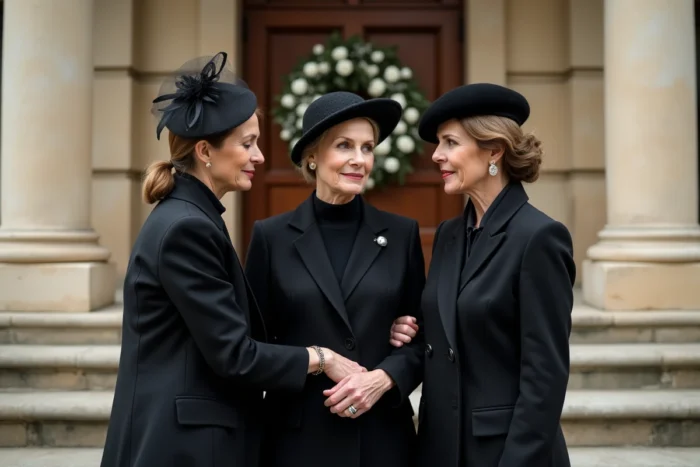
- The bibi or small hat with a veil, worn slightly tilted, remains the style most associated with funerals. Its small size does not obstruct the view of those seated behind you.
- The cloche hat, with its short brim and simple line, is suitable for both indoor and outdoor ceremonies. It pairs easily with a dark coat or suit.
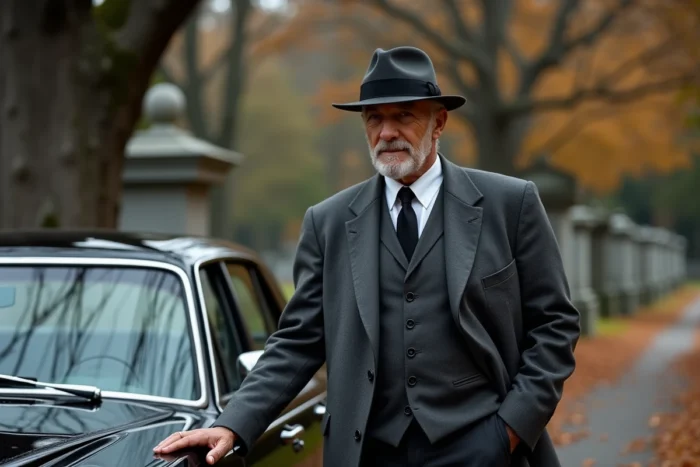
- The narrow-brimmed fedora, in a felt and solid version, works well for both women and men, provided it stays in dark shades.
Avoid wide-brimmed hats, straw hats, and styles adorned with flowers or colorful ribbons. The rule is simple: if the hat could be suitable for a summer wedding, it has no place at a funeral.
Colors to Favor
Black remains the safe choice. Navy blue, anthracite gray, and dark purple are also acceptable. These colors match mourning attire without creating an inappropriate contrast. A white or cream hat, even if simple in shape, risks drawing attention to you rather than the ceremony.
Hat for Men at Funerals: Common Mistakes
Men wear hats less frequently at funerals, but when they do, a few pitfalls regularly arise.
The first reflex should be: check if the family has expressed any dress wishes. Some families request strict attire, while others prefer a more relaxed atmosphere. In the absence of guidance, sobriety should guide the choice.
A black or dark gray felt hat, like a classic fedora, is suitable for most ceremonies. The bowler hat, once worn at British funerals, has nearly disappeared from contemporary usage. As for the cap, it is still seen as too casual for funerals, even in dark tones.
The beanie presents a different question. In winter, in cold weather, no one will fault you for protecting your head at the cemetery. Just remove it upon entering the place of worship or the ceremony hall. This gesture is enough to show respect.
Adapting the Hat to the Type of Funeral Ceremony
Why does this topic generate so much confusion? Because there is no uniform funeral dress code in France. Expectations change depending on the religious setting, the region, and the wishes of the deceased or their family.
For a religious ceremony (Catholic, Protestant, Orthodox), conventions are more pronounced. Women’s hats are generally well-received, while men’s hats should be removed inside the building.
For Muslim funerals, head covering has a different significance, linked to religious prescriptions. Women often cover their hair out of respect. Men may wear a skullcap. It’s best to inquire with the family if you are not familiar with the customs.
At a secular ceremony, there is more freedom. Intention matters more than form: a discreet hat worn with a sober outfit will always be appropriate.
Material and Care of the Mourning Hat
Wool felt remains the most suitable material for funerals. It absorbs light rather than reflecting it, enhancing the accessory’s sober appearance. Dark velvet also works for small women’s models.
To avoid:
- Straw and raffia, associated with summer attire
- Satin or shiny materials, which capture light and draw the eye
- Patent leather or metallic finishes, too flashy for the context
Brush the hat the day before the ceremony with a soft brush, in the direction of the fibers. A dusty or misshapen felt gives an impression of carelessness that undermines the intention of respect. If the hat has been stored for a long time, steam it for a few minutes to restore its shape.
Ultimately, the hat at funerals obeys only one principle: not to distract attention from what matters. Whether worn or left at home, it is the coherence with the rest of the outfit and the attention paid to the family’s wishes that makes the difference. A simple headpiece, removed at the appropriate moments, remains a gesture of elegance and consideration for the deceased and their loved ones.