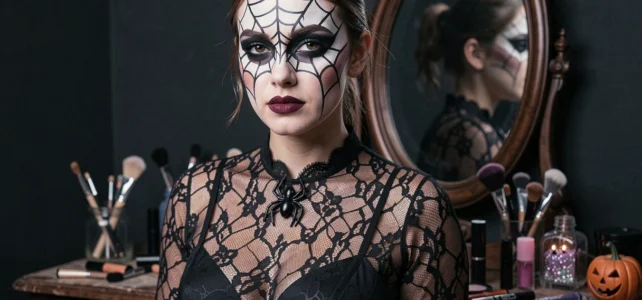
Drawing a spider on a made-up face requires neither artistic talent nor professional materials. A black liner, a dark eyeshadow, and a few minutes are enough to transition from a classic smoky eye to a bold Halloween look. The idea is not to recreate a monster mask, but to incorporate a spider detail into a makeup look that you could almost wear on an ordinary party night.
Glamorous spider makeup: focus on contrast rather than gore
The strong trend of recent Halloween seasons leans towards romantic gothic rather than pure gore. Dark and refined looks, lace or spider web details, and metallic glitter replace fake blood and latex scars. Spider makeup fits perfectly into this direction.
The principle is simple: create a highly detailed eye (black smoky, dark red, or deep purple ombre) and then add a spider element on top. The contrast between a polished complexion and a scary pattern creates a glamorous effect. Several detailed approaches on the blog Mes Petites Beautés show how to maintain this balance between elegance and thrill.
Have you noticed that the most shared Halloween looks are almost never the most elaborate? A small spider body drawn at the outer corner of the eye, with thin legs following the lash line, is enough to transform a smoky eye into a seasonal makeup.
Drawing a spider with black liner: step-by-step technique
Before drawing anything, prepare the eyelid. A black or dark gray eyeshadow blended on the mobile eyelid creates a dark background that gives depth to the spider. Add a touch of dark red in the crease for depth.
The spider’s body
With a fine-tipped black liner, draw a small oval (about the size of a lens) on the temple, just above the tail of the eyebrow or at the outer corner of the eye. Fill it in. This filled point becomes the body of the spider.
The legs: four on each side
Draw four thin lines on each side of the body, slightly curved outward. The upper legs rise towards the forehead, while the lower ones descend towards the cheekbone. Each leg makes a small angle in the middle, like a bent knee.
Keep your hand light. Legs that are too thick result in a cartoonish look. Thin and irregular legs appear more realistic and elegant.
Add a spider web around the eye
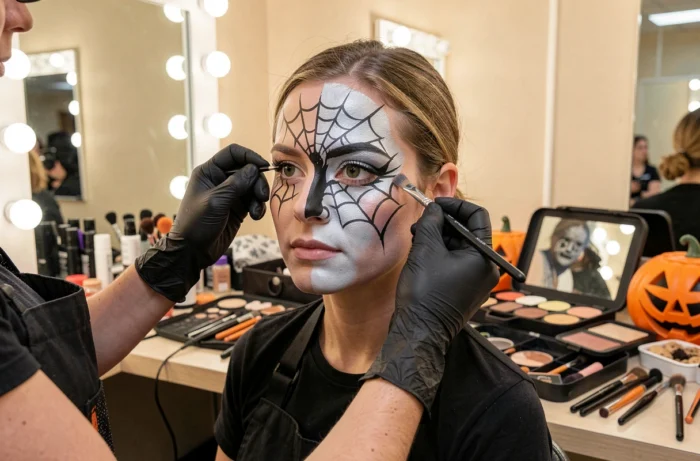
To go further, draw a partial web around the spider. Draw two or three straight lines extending from the corner of the eye towards the temple (like rays). Connect them with small concentric arcs. There’s no need to cover the entire temple: a discreet half-web enhances the look without weighing it down.
Products for successful spider makeup without irritation
The choice of products is as important as the technique, especially for makeup that needs to last all evening. Here are the essentials:
- A waterproof black eyeliner with a fine tip to draw the legs and body. The felt tip offers more precision than a gel liner for this type of detailed drawing.
- A matte black eyeshadow and a dark red or burgundy eyeshadow for the smoky base. Matte textures hold better and do not create a reflection that washes out the design.
- A makeup setting spray, to be sprayed once the drawing is complete, to prevent the liner from smudging with sweat or humidity.
- Cosmetic glitter (gold or silver) to be applied with your finger on the spider’s body or along the web if you’re aiming for a more festive than sinister look.
Why these details? Because a smudged liner turns a spider into a blotch. The precision of the line directly depends on the quality of the tip and the product’s hold.
Spider makeup for children: adapting the drawing and products
On a child’s face, there’s no need to replicate a dark smoky eye. Spider makeup simplifies: a small round body on the cheek or forehead, four legs on each side, and you’re done. Children often prefer a spider that is clearly visible, almost funny, rather than a dark look.
Use only makeup formulated for children or water-based face painting products. These products can be removed with warm water and limit the risk of irritation on sensitive skin.
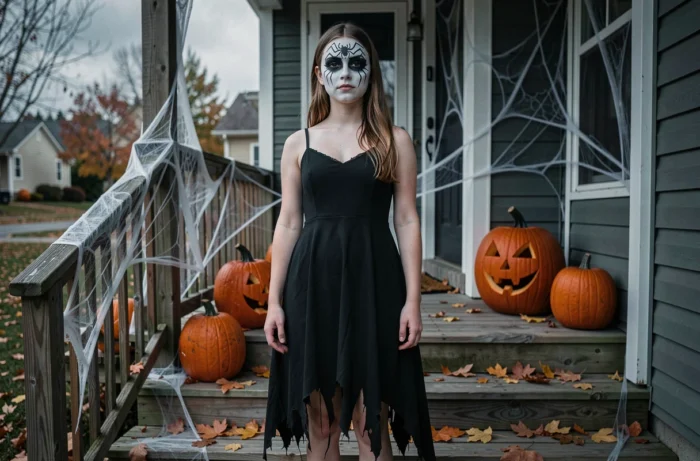
To add a touch of color, replace the solid black with a white and black duo. Draw the web in white on the cheek, then the spider in black on top. The contrast draws the eye and keeps the result playful.
Labeling Halloween cosmetics: what changes starting in 2026
If you buy your spider makeup products at a supermarket or online, a European regulatory change deserves your attention. Starting July 30, 2026, a European implementing decision (EU 2025/1175) requires that all cosmetic colorants be declared by their Colour Index (CI) number on the label.
In practice, black liners, red eyeshadows, and metallic pigments used in Halloween makeup will need to clearly display these CI numbers. Old ingredient references will no longer be compliant. This makes it easier to read compositions and allows for quick identification of potentially irritating pigments.
Checking the INCI list of a Halloween makeup product thus becomes simpler, provided you know that this obligation exists. For parents who are applying makeup on their children, it’s a useful guideline to avoid products with unclear labeling.
A successful spider makeup ultimately comes down to three choices: a good liner, a well-blended shadow base, and a design that remains simple. The sophistication comes from the contrast between the care taken with the complexion and the spider detail, not from the complexity of the drawing.