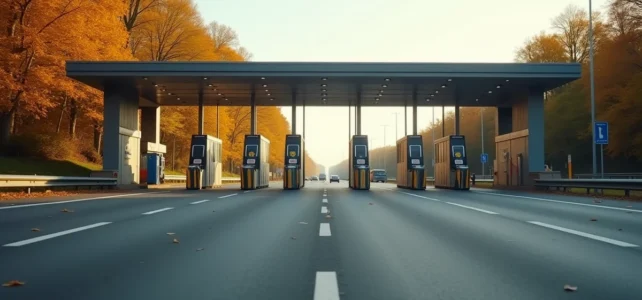
Since February 1, 2026, physical toll barriers are gradually disappearing on several routes of the French motorway network. The term “free motorways” is circulating widely online, fueled by the confusion between the removal of barriers and the elimination of payment. The network is evolving towards a radically different technical model, free-flow tolling, without questioning the principle of pricing.
Free-flow on motorways: what the disappearance of barriers really changes
Free-flow tolling relies on gantries equipped with sensors and cameras capable of reading license plates or identifying a toll badge. Vehicles no longer stop. Billing occurs after passage, within a given timeframe.
ATMB, the operator of the A40, specifies that barrier-free tolling is expected to become widespread across the entire network within about fifteen years. The operator presents this transition as a strategic choice motivated by environmental reasons, not as a step towards free access. Several routes have already transitioned or are in the process of conversion, particularly on the Sanef network between Paris and Normandy.
The nuance can be summed up in one sentence: free-flow does not mean free access. Billing remains the same; only the physical infrastructure of the barrier disappears. Ulys guides and press releases from concessionaires consistently remind this, which raises several news articles on Pulsion Laval dedicated to this distinction.

Free motorways in France: what actually exists without tolls
About a quarter of the French motorway network remains accessible without tolls. Three main routes concentrate most of the free mileage:
- The A75, known as the Méridienne, connects Clermont-Ferrand to Béziers over more than 300 km without tolls (the Millau Viaduct is the only paid exception on this route).
- The A20, known as the Occitane, offers several hundred kilometers of free sections between Limoges and Montauban.
- The A84 connects Caen to Rennes without any tolls along its entire route.
Brittany retains a special status: all of its expressways remain free, a legacy dating back to the late 1960s. In Alsace, the A35 and A25 in the North complete this network without barriers or billing.
These free routes are not the result of recent policy. They correspond to land use choices made several decades ago, often to compensate for a lack of accessibility in certain regions. Nothing in the current government announcements suggests an expansion of this free perimeter.
Toll rate increases 2026: the figures network by network
Far from a scenario of free access, rates have been revised upward as of February 1, 2026. The average increase is set at 0.9%, a rate slightly below inflation but which adds to the cumulative increases of previous years.
Disparities between networks persist. According to data published by Le Parisien, increases vary from 0.82% to 0.95% depending on the concessionaires. For a regular trip on a route like Paris-Marseille, the toll now exceeds 50 euros for passenger vehicles.
The revision mechanism is regulated by the State, which sets the annual ceiling for increases applicable on February 1. The concession contracts, signed for long durations, provide for indexing formulas linked to inflation and investments made by the concession companies. As long as these contracts are in effect, the pricing structure remains locked.
Works and investments: a factor for increases to watch
Several concessionaires have announced heavy modernization programs, particularly related to the deployment of free-flow tolling and the renovation of aging structures. These investments could justify additional increases in upcoming rate revisions. Field feedback varies on this point: some operators incorporate these costs into existing budgets, while others negotiate amendments.
Free-flow tolling and payment forgetfulness: the concrete risk for motorists
The generalization of free-flow creates an unexpected trap. Without a physical barrier, nothing reminds the driver that they have just passed a paid toll point. Several regional media have documented cases of motorists receiving penalties for non-payment after passing through a route converted to free-flow.
The operation is as follows: after passing under the gantry, the user has a timeframe (variable depending on the operators) to pay online or via an app. After this period, a penalty is automatically applied. Holders of a toll badge are charged without intervention, but occasional users without a badge are the most exposed to forgetfulness.
Operators’ recommendations converge on three points:
- Check before a trip if the route taken has switched to free-flow, as ground signage can sometimes be discreet.
- Prefer a toll badge to avoid any manual steps after passing.
- Consult the concerned concessionaire’s website in the days following the trip to ensure no bill is pending.
The French motorway network is modernizing rapidly, but this modernization does not equate to free access. Barriers are falling, payment remains. For motorists, the issue in 2026 is not to drive without paying, but to understand a billing system that has become invisible, where the absence of action at the toll does not mean the absence of a bill.